Sourcing volume components requires balancing aggressive unit economics with uncompromising durability. Safety standards remain paramount in the demanding marine environment. When you purchase boat hardware at scale, even minor defects multiply rapidly across your production line or retail shelves. Low-tier imports or unverified suppliers often mask inferior alloys behind a polished finish. These hidden shortcuts inevitably lead to premature corrosion, costly warranty claims, and catastrophic failures in harsh saltwater conditions.
We created this comprehensive guide to help you avoid these pitfalls. It provides a clear, actionable framework for evaluating and shortlisting reliable B2B suppliers for volume procurement. You will learn how to navigate material certifications, compare different vendor types, and secure the best long-term partners for your business. By implementing these strategies, you ensure product integrity while protecting your bottom line.
Key Takeaways
Procurement success relies on verifying material certifications (e.g., Mill Test Reports) before committing to high-volume orders.
The optimal supplier type—direct manufacturer, wholesale distributor, or B2B portal—depends heavily on your Minimum Order Quantity (MOQ) and lead-time flexibility.
Standardizing high-turnover items (like marine cleats and hinges) through a single audited vendor reduces freight costs and supply chain friction.
Always test small-batch samples for threading precision, polishing consistency, and alloy grade (316 vs. 304 stainless) before scaling the purchase.
Key Avenues for Sourcing Marine Supply & Hardware in Bulk
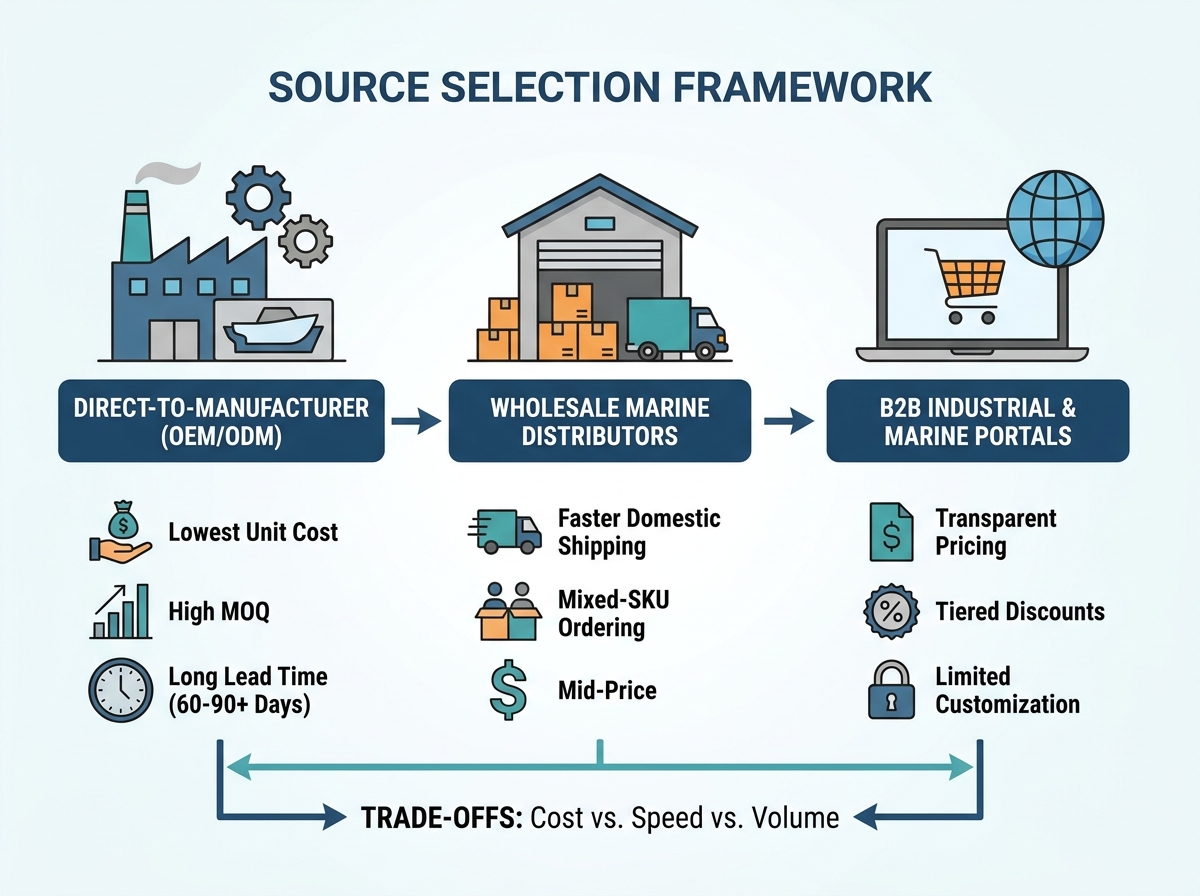
Choosing the right vendor category dictates your pricing, lead times, and customization limits. Buyers seeking marine supply & hardware at scale generally choose between three primary avenues. Each channel serves a distinct operational model.
Direct-to-Manufacturer (OEM/ODM Facilities)
Working directly with manufacturing facilities offers the lowest possible unit cost. This route is best for large boat builders and industrial fabricators. If you require custom molds, bespoke designs, or massive volume, direct factories provide unmatched scalability. However, this channel demands the highest Minimum Order Quantities (MOQs). Lead times stretch significantly. You often wait 60 to 90 days for production and overseas shipping. You also assume responsibility for managing import logistics and complex customs clearances.
Wholesale Marine Distributors
Wholesale distributors act as regional middlemen. They hold vast domestic inventory. This channel works best for marinas, mid-size repair yards, and local retailers. Distributors offer much faster shipping times. They also allow mixed-SKU ordering. You can combine different parts into a single shipment to reach volume discount tiers. The trade-off is a slightly higher unit cost due to the middleman markup. Yet, the convenience of avoiding international freight delays often justifies this premium.
B2B Industrial & Marine Portals
Online B2B portals bridge the gap between factories and smaller buyers. They suit operations needing predictable, tiered bulk pricing without negotiating complex annual contracts. Pricing transparency is highly visible on these platforms. You simply select a volume tier and checkout. The drawbacks include limited customization options. You might also encounter sudden stock limitations during peak boating seasons. Portals work best for standardized, off-the-shelf components.
Supplier Type Comparison Chart
Supplier Type
Ideal Buyer Profile
Cost Efficiency
Lead Time
Customization
Direct-to-Manufacturer
Boat Builders, Large Fabricators
Highest (Lowest Unit Cost)
Slowest (60-90+ Days)
Extensive (Custom Molds)
Wholesale Distributors
Marinas, Repair Yards
Moderate (Markup Applied)
Fastest (Domestic Shipping)
Minimal
B2B Portals
Small Operations, Retailers
Good (Tiered Pricing)
Variable
None
Defining "High-Quality": Non-Negotiable Material Standards
Quality in marine environments is not subjective. It relies strictly on metallurgical chemistry and precise manufacturing processes. Securing durable stainless marine hardware requires setting firm benchmarks before you issue a purchase order.
Alloy Verification for Stainless Components
You must establish a mandatory threshold for materials exposed to saltwater. Grade 316 marine stainless steel is non-negotiable here. Unlike 304 grade, 316 contains molybdenum. This specific addition drastically increases resistance to chloride corrosion. Many cheap imports label 304 as "marine grade," which is highly misleading.
To verify the alloy, you must demand Mill Test Reports (MTRs) from potential suppliers. An MTR provides the exact chemical breakdown of the steel heat lot. It acts as the ultimate proof of material integrity. Never accept visual inspections alone. A polished piece of 304 looks identical to 316 until saltwater hits it.
Finish and Casting Quality
Surface treatments determine how long a part remains pristine. You must evaluate the electro-polishing and passivation processes used by the factory. Proper passivation removes free iron from the surface. This prevents "tea-staining"—the ugly brown rust streaks often seen on cheap marine components.
You must also check for porosity in cast metals. Porosity refers to microscopic air bubbles trapped inside the metal during casting. It serves as a leading indicator of structural weakness. Under sudden load, porous hardware snaps without warning. Inspect sample cross-sections to ensure the factory maintains strict temperature and pouring controls.
Precision and Tolerances
Moving parts demand tight manufacturing tolerances to function safely over time. When evaluating items like marine hardware hinges, you must check them for smooth actuation. Assess pin stability. Are the hinge pins loose? Do they rattle? You should also test the hinge under load to ensure a complete lack of grinding. Poorly machined threads on bolts or unevenly cast mounting holes slow down assembly times and compromise vessel integrity.
Sourcing High-Volume Categories: Cleats, Hinges, and Dock Supplies
Different categories demand different procurement strategies. Purchasing deck hardware requires a distinct approach compared to securing heavy infrastructure components.
Securing Marine Cleats for Sale at Scale
Finding a reliable marine cleats for sale source means looking past aesthetic appeal. You must evaluate load-rating claims against actual fastener requirements. A beautifully cast cleat will fail if its mounting base cannot accommodate adequately sized bolts. You must ensure the backing-plate dimensions match the anticipated sheer loads.
When searching for a specific boat cleat for sale in bulk, look for vendors offering diverse variations. Consolidating orders for pop-up cleats, folding cleats, and fixed horn cleats under one supplier helps you hit higher pricing tiers. It also ensures consistent visual styling across your entire product line or fleet.
Procuring Boat Dock Supply Components
Dockside infrastructure follows different metallurgical rules than onboard fittings. When securing a boat dock supply order, you must differentiate between weight-sensitive onboard hardware and massive dock-side hardware.
Onboard fittings require lightweight, highly polished 316 stainless steel. Conversely, dockside hardware often utilizes hot-dipped galvanized steel to handle massive load requirements at a lower cost. You must also factor in extreme freight weights. Bulk dock chains, heavy-duty cleats, and steel piling hoops are incredibly dense. The shipping costs for these items can easily exceed the cost of the goods themselves if not calculated correctly upfront.
Onboard vs. Dockside Hardware Specifications
Specification Feature
Onboard Hardware
Dockside Hardware
Primary Material
316 Stainless Steel, Aluminum
Hot-Dipped Galvanized Steel
Weight Priority
Lightweight, Highly Optimized
Massive, Heavy-Duty
Surface Finish
Electro-polished, High Gloss
Rough, Utilitarian Galvanized Coating
Corrosion Defense
Molybdenum Alloy Base
Thick Zinc Sacrificial Coating
Implementation Risks and Supplier Red Flags
Purchasing raw components in bulk carries inherent financial risks. Even experienced procurement managers occasionally miss subtle red flags during vendor negotiations.
Hidden Freight and Logistics Costs
Calculating the true landed cost is an absolute necessity. Favorable unit pricing is frequently negated by exorbitant LTL (Less-Than-Truckload) or international shipping fees. Bulk hardware is exceptionally heavy. A pallet of stainless steel cleats maxes out weight limits long before it fills a truck's cubic volume. If a supplier quotes "FOB" (Free On Board), you bear the responsibility and cost of the final oceanic and domestic transit. Always calculate your fully landed cost before finalizing margin projections.
Inconsistent Batch Quality
Beware of the "golden sample" trap. This happens when a supplier provides a flawless initial prototype but delivers porous, poorly polished bulk units later. Often, unscrupulous factories assign their master technicians to create the sample. They then subcontract the actual production run to a cheaper, unverified secondary facility. To combat this, you must demand production-run samples before releasing final payments.
Unclear Return & Defect Policies
You must define Service Level Agreements (SLAs) regarding acceptable defect rates before signing any contracts. In mass manufacturing, a zero percent defect rate is a myth. You might encounter cross-threaded bolts or minor surface scratches. You need to establish exact percentages for what constitutes an acceptable tolerance. Establish clear chargeback mechanisms or automatic replacement terms for any batch exceeding the agreed-upon defect threshold.
Shortlisting Logic: How to Vet Your Next Boat Hardware Supplier
Systematic vetting protects your capital. Do not rely on marketing brochures. Follow this structured, sequential framework to identify and secure reliable factory partners.
Step 1: The RFI (Request for Information): Start by asking targeted questions. Request their standard MOQs and average lead times. Demand to see recent material certifications (MTRs) for your top three required SKUs. If they hesitate to share chemical data, eliminate them immediately.
Step 2: The Sample Order: Purchase a mixed-basket sample. Do not ask for free samples; paying for them tests their invoicing and shipping speed. Order one heavy-load cleat, one precision hinge, and one cosmetic fastener. This tests their real-world casting quality, moving-part precision, and polishing consistency simultaneously.
Step 3: Facility or Process Audits: For large-scale buyers, hire third-party QA inspectors. Send them to the factory level prior to container shipment. An independent auditor will check the production line, verify worker conditions, and perform random chemical drop tests on the finished goods before they enter the shipping container.
Step 4: Pilot Order: Execute a limited Q1 order. Think of this as a probationary period. Test their communication, their ability to meet deadlines, and their packaging durability under real transit conditions before committing to an annual supply contract.
Conclusion
Buying boat hardware in bulk is a strategic risk-management exercise, not just a price-shopping endeavor. Your decisions directly impact vessel safety, brand reputation, and long-term profitability. Prioritize suppliers that offer transparent material data, scalable freight solutions, and consistent batch-to-batch quality. Do not sacrifice alloy integrity for a marginal drop in unit price.
Your next step is immediate action. Audit your current hardware failure rates to identify weak points in your supply chain. Then, draft a standardized Request for Quote (RFQ) detailing your exact stainless grade requirements, load expectations, and acceptable defect thresholds. Sending this detailed RFQ to your shortlisted vendors will immediately separate the true manufacturers from the unreliable middlemen.
FAQ
Q: What is the minimum order quantity (MOQ) typically required for bulk boat hardware pricing?
A: MOQs vary heavily by supplier type. Standard B2B portals typically require ranges from 50 to 100 units. Direct overseas manufacturing often demands 1,000+ units per SKU to cover mold setup and factory tooling costs.
Q: How can I verify that bulk stainless marine hardware is actually 316 grade?
A: Request Mill Test Reports (MTRs) directly from the supplier. Alternatively, you can use a chemical drop test kit on the initial samples. For large contracts, send a sample to a third-party metallurgy lab for independent spectrographic analysis.
Q: Does bulk pricing usually include freight costs for heavy marine supplies?
A: Rarely. Heavy items like dock supply components usually require custom LTL freight quotes. These shipping expenses must be calculated separately and factored into your final landed per-unit cost.
Q: Can I mix and match items to reach bulk discount tiers?
A: Wholesale distributors typically allow mixed-SKU volume discounts, letting you combine orders. Direct manufacturers, however, usually require strict MOQs per specific item or mold to justify their production runs.