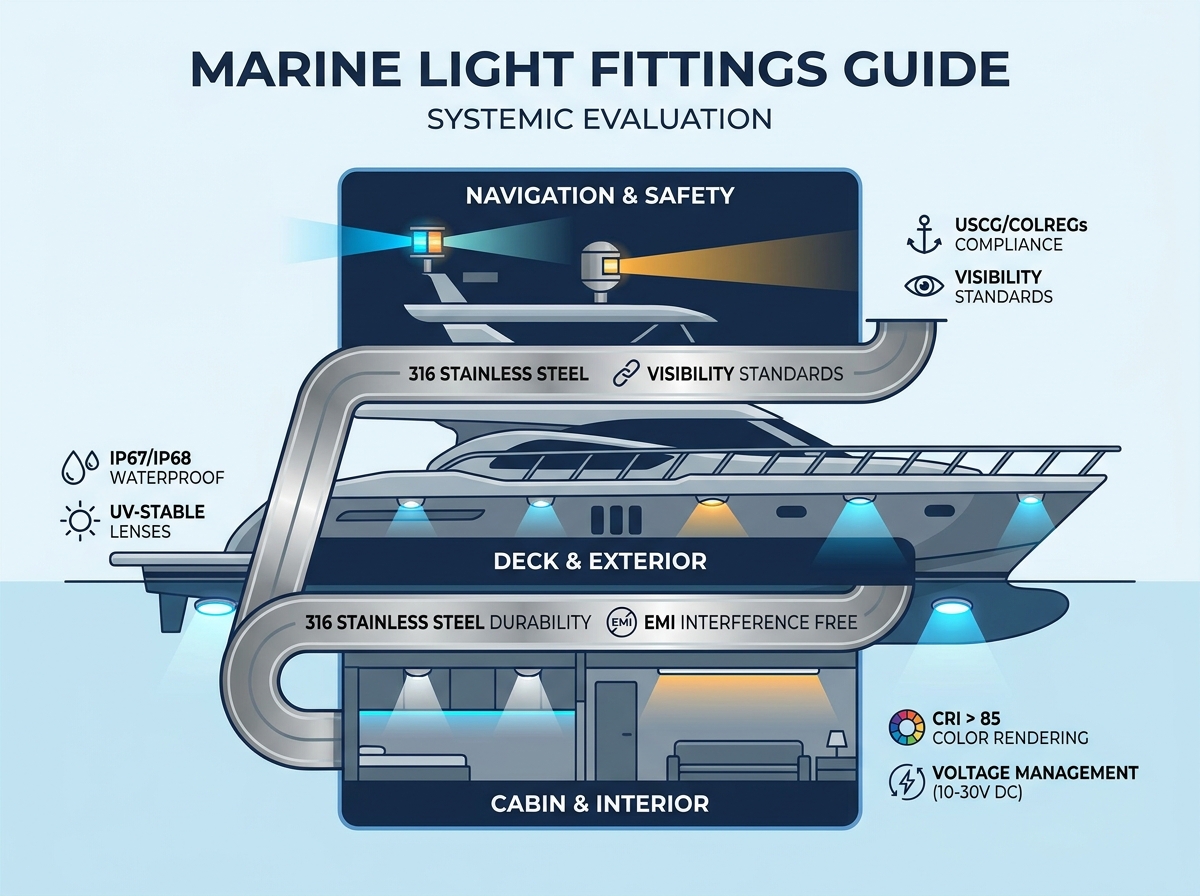
Selecting marine lighting is rarely just an aesthetic decision. It represents a critical intersection of vessel safety, regulatory compliance, and long-term hardware durability. You know the harsh reality of the open sea. Saltwater easily destroys weak metals while voltage spikes routinely fry fragile electronics. For yacht owners and refitters, the burden of premature fixture failure extends far beyond ordering replacement parts. You inevitably face laborious rewiring tasks, potential gelcoat damage during removal, and serious navigation hazards mid-voyage. This guide breaks down exactly how you should evaluate, shortlist, and implement reliable fixtures. We will show you how to source robust solutions enduring brutal marine environments. You will learn to accomplish this without ever compromising on performance, safety, or vessel design.
Key Takeaways
- Compliance is Non-Negotiable: Navigation lights must meet strict USCG/COLREGs visibility standards; failure to verify certifications introduces severe liability.
- Material Grades Dictate Lifespan: True marine durability requires 316/316L stainless steel, not standard 304, to resist pitting and galvanic corrosion.
- EMI Matters: Subpar LED drivers create electromagnetic interference (EMI) that can blind VHF and AIS systems.
- Systemic Evaluation: Matching yacht fittings and hardware across deck and cabin environments requires assessing IP ratings, voltage tolerances, and thermal management alongside aesthetic continuity.
The Business and Safety Case for Premium Marine Light Fittings
You face significant risks when installing lower-grade commercial lighting on marine vessels. Standard residential or commercial lights lack the ruggedization necessary for ocean travel. They suffer rapid corrosion when exposed continuously to salty air. Furthermore, standard electronics burn out quickly due to heavy voltage spikes common on boats. When navigation lights fail at sea, you instantly compromise the safety of everyone aboard.
Evaluating high-end marine light fittings requires a long-term perspective. You must plan for a 10-year operational lifespan rather than focusing on initial acquisition. Repeatedly replacing cheaper alternatives disrupts cruising schedules and demands intensive manual labor. High-quality fixtures eliminate these repetitive maintenance cycles. They guarantee consistent performance across diverse weather conditions. They also protect the underlying integrity of your fiberglass structures by minimizing repeated drilling.
We define a successful installation through several strict criteria. You should demand perfection across these operational metrics:
- Zero electromagnetic interference affecting onboard VHF or AIS communications.
- Consistent color rendering index (CRI) across all cabin and deck zones.
- Complete absence of galvanic corrosion between the fixture and the mounting surface.
- Verifiable regulatory compliance supporting your vessel insurance policies.
![yacht fittings]()
Solution Categories: Navigation, Deck, and Cabin Lighting
A vessel requires distinctly different lighting solutions across its various zones. You must categorize your approach to ensure proper functionality and absolute legal compliance.
- Navigation and Safety Lights: You must strictly follow legal requirements established by COLREGs and ABYC standards. Evaluate visibility ranges carefully. Coastal cruisers might need 2NM visibility. Offshore vessels often require 3NM visibility. Exact mounting angles are crucial. Incorrect angles project confusing signals to approaching traffic.
- Exterior Deck Lighting: You must assess specific yacht deck fittings handling spreaders, underwater illumination, and courtesy steps. These environments demand IP67 to IP68 waterproof ratings. Underwater models strictly require IP68. Exterior lenses must feature UV-stable polycarbonate. This prevents yellowing and cracking under intense tropical sunlight.
- Interior and Cabin Lighting: Cabin environments demand different technical specs. Evaluate these fixtures based on a Color Rendering Index exceeding 85. High CRI ensures natural skin tones and vibrant wood finishes. Dimming compatibility is essential for evening comfort. Look for low-profile designs accommodating shallow headliners without protruding awkwardly.
Material Selection: Why Stainless Steel Dominates
Material science dictates the ultimate survival of your deck hardware. The ocean actively attacks inferior metals through constant oxidation and chloride exposure.
You must understand the critical divide between 316 and 304 stainless alloys. Engineers measure corrosion resistance using the Pitting Resistance Equivalent Number (PREN). Marine environments strictly demand 316 or 316L stainless steel yacht fittings. The 316 alloy contains molybdenum. This specific addition drastically increases resistance to chloride pitting. Standard 304 alloy lacks this protection. It quickly develops unsightly tea-staining rust streaks across your pristine deck.
Hardware cohesion holds immense aesthetic and functional value. Matching your light bezels alongside other stainless boat accessories creates a highly unified deck profile. You want the finish of your courtesy lights complementing your cleats. Tie your exterior lighting directly into your boat railing accessories. Consistent material grades ensure everything ages uniformly over a decade of use.
While stainless dominates, alternative materials serve specific niches. Marine-grade aluminum offers substantial weight savings aloft. Manufacturers heavily anodize or powder-coat aluminum spreader lights. Advanced composites provide absolute immunity to corrosion. However, composites often lack the premium visual appeal demanded by luxury yacht owners.
Material Comparison Chart for Marine Hardware | Material Grade | Corrosion Resistance | Best Application Areas | Visual Cohesion |
| 316/316L Stainless | Excellent (High PREN) | Deck level, underwater, handrails | Premium, matches other hardware |
| 304 Stainless | Poor in Saltwater | Dry interior cabins only | Prone to tea-staining outside |
| Anodized Aluminum | Good (if coating holds) | Masthead, spreaders (weight saving) | Utilitarian, modern |
| Advanced Composites | Absolute Immunity | Utility spaces, hidden mounts | Basic, lacks metallic luster |
Technical Evaluation Criteria for LED Yacht Fittings
Beneath the polished metal exteriors, the internal electronics determine the true reliability of any fixture. LED technology introduces specific engineering challenges.
Vessels experience extremely harsh voltage fluctuations. Starting large diesel engines drops system voltage rapidly. Alternators and high-draw pumps create massive voltage spikes. You must evaluate fixtures containing robust internal drivers. Demand drivers capable of handling 10-30V DC continuous input. This wide tolerance completely isolates delicate LED chips from destructive electrical surges.
Thermal management plays an equally vital role. LEDs degrade rapidly from excessive heat. Water ingress is not the only enemy. High-powered chips generate substantial thermal loads. Look closely for substantial metal heat sinks built into the chassis. Avoid entirely enclosed plastic housings lacking thermal pathways. Proper heat dissipation guarantees the LEDs maintain their brightness over thousands of hours.
Electromagnetic Interference (EMI) serves as a critical trustworthiness check. Subpar LED drivers utilize cheap pulse-width modulation techniques. These cheap drivers broadcast radio frequencies across your boat. This EMI easily jams onboard communications. It can completely blind your VHF radios and AIS receivers. Detail your requirements clearly to suppliers. Verify fixtures carry FCC Part 15 compliance or strict CE certifications. This ensures they never compromise vital safety equipment.
Implementation Risks: Mounting, Wiring, and Corrosion
Even the finest hardware fails quickly if installed improperly. Implementation requires meticulous attention to physical and electrical details.
Galvanic corrosion destroys dissimilar metals rapidly. You face this reality whenever mounting stainless steel fixtures onto aluminum masts. The same danger applies to carbon fiber hulls. You must mandate the use of isolating compounds during installation. Products like Tef-Gel or Duralac act as protective barriers. They prevent the exchange of electrons between the metals. This simple step prevents expensive structural degradation.
Water inherently seeks paths inside your vessel. It actively wicks up unprotected cables. Detail your wiring approach carefully. Always mandate marine-grade tinned copper wire. Bare copper turns black and brittle near saltwater. Install generous drip loops before cables enter the hull. Utilize fully sealed cable glands at every penetration point. These practices stop capillary action dead in its tracks.
Retrofitting presents its own set of realities. Replacing old halogen fixtures often reveals mismatched footprints. Modern LED units are typically smaller and thinner. You face the challenge of covering old screw holes and unpainted gelcoat. Plan your selections carefully around existing cutouts. Sourcing adapter plates often saves you from undertaking costly fiberglass patching and color-matching projects.
Shortlisting Logic: How to Choose the Right Supplier
The marine industry floods the market with cheap imports claiming false durability. You must apply strict shortlisting logic to separate premium manufacturers from generic brands.
Never accept generic "marine grade" claims at face value. This marketing term holds zero regulatory weight. Demand verifiable documentation instead. Look specifically for USCG, CE, or ABYC approval certificates. Legitimate manufacturers proudly publish their independent testing results. They readily supply photometry reports and EMI testing data upon request. Incorporating high-quality yacht fittings and hardware demands this level of transparency.
Evaluate the pragmatism behind the manufacturer's warranty. Warranties reveal a company's internal confidence in its engineering. A 5-year warranty covering electronic drivers is the current industry benchmark. Premium suppliers often extend a lifetime warranty covering the physical stainless housing. Avoid brands offering mere one-year guarantees. They expect their products to fail shortly after exposure.
We recommend a specific next-step action before committing to a full refit. Purchase a single unit from your shortlisted vendor. Conduct a rigorous bench test aboard your vessel. Check the dimming curves for smooth operation. Verify the color temperature matches your expectations. Most importantly, turn the light on while holding a handheld VHF radio inches away. Listen closely for static interference. This practical test validates their EMI claims instantly.
Conclusion
Selecting the right yacht fittings requires moving far past simple aesthetic preferences. You must rigorously evaluate material science, electrical engineering, and regulatory compliance. Proper illumination directly impacts your safety, your comfort, and your vessel's structural integrity.
- Prioritize 316 Stainless: Always choose 316/316L alloys over 304 for exterior placements to prevent rapid degradation.
- Demand Wide Voltage Tolerances: Specify 10-30V DC drivers to protect LEDs from inevitable alternator spikes.
- Verify EMI Compliance: Protect your communication gear by confirming FCC Part 15 or CE marks.
- Conduct Bench Tests: Validate color rendering and radio interference personally before executing full-vessel installations.
- Isolate Metals: Always utilize premium isolating compounds when mounting fixtures against dissimilar mast or hull materials.
Encourage your purchasing team to prioritize vendors demonstrating complete transparency. Demand visibility into their LED binning processes. Request their official EMI testing documentation. Verify their specific metal grades. Taking these calculated steps ensures your vessel operates safely and beautifully for years.
FAQ
Q: What IP rating do I need for exterior yacht deck fittings?
A: IP ratings define protection against solids and liquids. IP65 withstands light spray but fails under pressure. You need a strict minimum of IP67 for deck installations. IP67 survives temporary immersion from heavy waves. For any underwater illumination, you must specify IP68. This rating guarantees continuous operation while fully submerged under pressure.
Q: Can I mix 304 and 316 stainless boat accessories?
A: We strongly advise against mixing these alloys on exterior decks. Standard 304 lacks molybdenum, making it highly susceptible to chloride pitting. It will quickly develop brown rust streaks. Meanwhile, your 316 hardware will remain pristine. This varying corrosion rate creates a glaring visual mismatch over time. Keep exterior metals uniformly 316/316L.
Q: Why do my new LED marine lights interfere with my VHF radio?
A: Cheap LED drivers use poorly engineered pulse-width modulation (PWM) to regulate current. These unshielded drivers emit strong radio frequencies. This electromagnetic interference (EMI) easily jams sensitive VHF and AIS receivers. You resolve this by replacing them. Install high-quality fixtures featuring shielded drivers tested for FCC Part 15 or CE compliance.
Q: Are standard residential LEDs safe to use in a yacht cabin?
A: No. Standard residential fixtures present severe fire and failure risks. They lack proper ignition protection required near engine spaces. Furthermore, their fragile internal drivers cannot handle the heavy vibration and massive voltage spikes produced by marine alternators. Always install purpose-built marine units to ensure absolute vessel safety.