A yacht’s canvas structural integrity relies entirely on its weakest articulation point. In heavy winds and corrosive saltwater environments, standard hardware fails rapidly. You need robust components designed specifically for extreme dynamic loads. Transitioning from generic boat parts to purpose-built, high-load hardware remains a critical decision. Subpar mounts jeopardize passenger safety offshore. They also ruin your vessel's sleek aesthetic appeal.
This guide breaks down the precise evaluation criteria for selecting premium yacht canopy and sprayhood hardware. We cut through generic marketing claims to focus strictly on structural specifications, material realities, and installation compatibility. You will learn exactly how to source reliable components tailored to your specific marine environment. Upgrading your hardware ensures lasting reliability across every demanding voyage.
Key Takeaways
- Material specification is non-negotiable: True marine environments demand AISI 316 stainless steel to prevent galvanic corrosion and structural fatigue.
- Component compatibility defines structural integrity: Properly matching tube diameters to specific jaw slides and eye ends prevents frame collapse under windage loads.
- Deck geometry dictates mount selection: Identifying the correct base angles and articulation profiles prevents torque stress on fiberglass decking.
The Cost of Hardware Failure on the Water
Marine environments brutally test exterior structures day and night. Continuous UV exposure degrades low-quality plastics rapidly. Cyclic wind loading flexes metal joints continuously. Saltwater immersion acts as an aggressive electrolyte, accelerating oxidation. These relentless environmental stressors easily destroy inferior canvas frames.
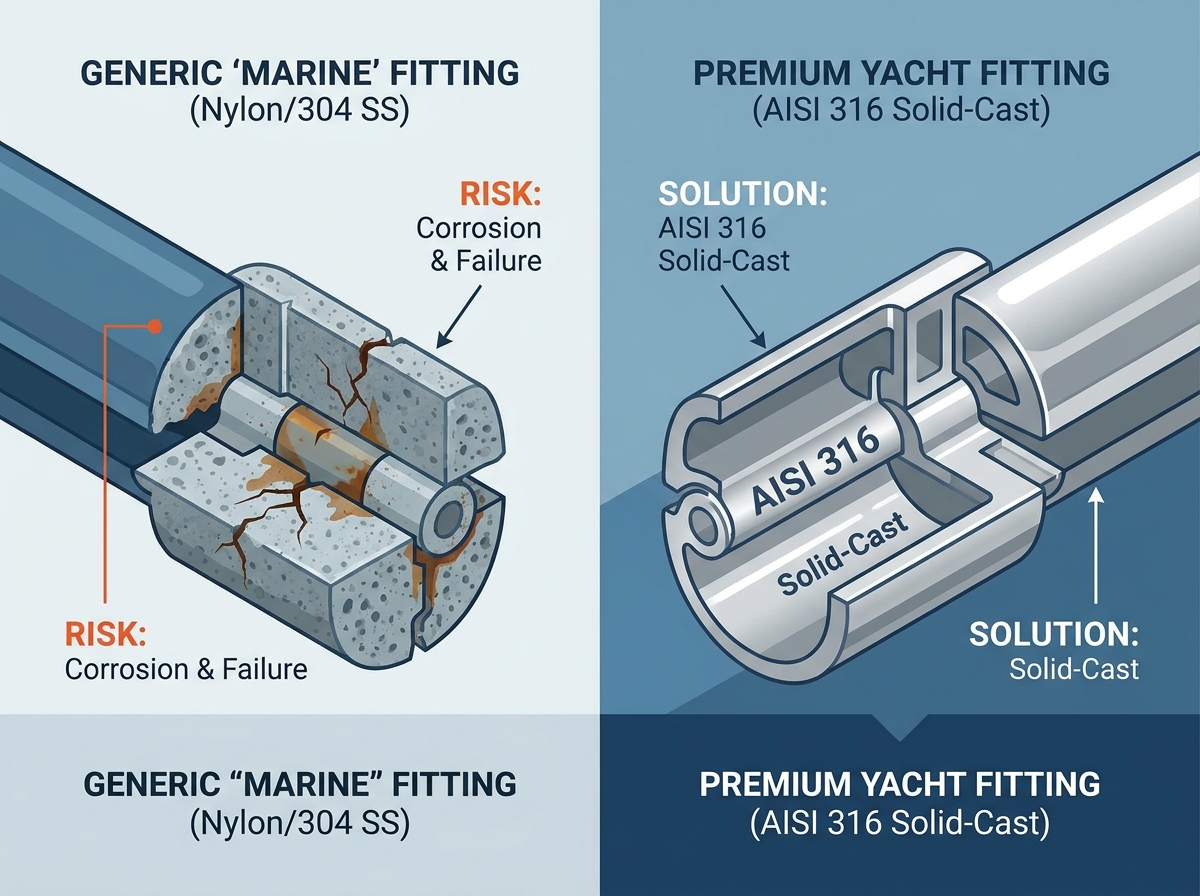
Budget suppliers frequently misuse the "marine-grade" label. They use it to mask inferior 304 stainless alloys. Sometimes they even supply hollow-cast pot metal components. These weak parts look incredibly shiny in the showroom. However, they fail catastrophically during your first offshore squall. Windage turns your canvas into a massive parachute. A sudden 40-knot gust exerts hundreds of pounds of upward force. When a primary hinge fractures under this load, the entire bimini frame collapses. This creates a severe safety hazard for your crew on deck.
You must define clear success criteria for your hardware upgrade. A successful installation exhibits zero rust weeping over many seasons. The articulation points remain completely silent underway. The assembled frame easily withstands its stated knot-wind ratings. You should notice absolutely no deformation after heavy weather. Relying on premium yacht fittings guarantees this exceptional level of performance. Superior hardware transforms a fragile sunshade into a robust safety barrier.
![Yacht canopy fittings and marine hardware layout]()
Categorizing Core Yacht Canopy Fittings
You must understand the distinct anatomy of your bimini or sprayhood frame. Each structural connection requires a specific hardware profile. Misapplying a fitting compromises the entire assembly.
Evaluating Framework Components
Tube terminations sit at the extreme ends of your tubular framework. Top caps and eye ends connect the main aluminum or steel hoops to the deck mounts. You need exceptionally secure insertion points. Quality eye ends utilize deep seating cavities. They feature robust, precisely threaded set screws. These elements prevent the tubing from pulling out under extreme tension.
Next, examine your yacht rail fittings. Jaw slides connect secondary bows to the main framework. You can choose between hinged and fixed jaw slides. Fixed slides offer maximum rigidity. Conversely, hinged split clamps provide a massive retrofit advantage. You can install split clamps directly over the existing tubing. They completely eliminate the frustrating need to disassemble your rails.
Evaluating Yacht Deck Fittings
The base mounts anchor everything securely to your hull. You will encounter flat, angled, and concave deck hinges in the market. You must match the hinge profile perfectly to your fiberglass surface.
Consider how frequently you stow your canvas. Quick-release pin systems work beautifully for daily folding. Permanent bolt configurations offer superior shear strength for rigid offshore setups. Track and slide systems allow adjustable tensioning. Low-friction cars glide smoothly along the track rails. They let you collapse or tension the sprayhood effortlessly. Integrating highly polished yacht deck fittings ensures smooth, bind-free operation across all weather conditions.
Hardware Evaluation Criteria Matrix
| Component Category | Primary Function | Critical Selection Criteria |
| Eye Ends | Tube-to-mount connection | Pin hole tolerance, set screw threading depth |
| Jaw Slides | Tube-to-tube articulation | Grip strength, hinge pin durability, inner diameter |
| Deck Hinges | Hull base anchoring | Surface footprint, pin shear strength, mounting angle |
| Top Caps | Terminal tube capping | Internal insertion depth, external wall thickness |
| Track Cars | Adjustable tensioning | Low-friction sliding, locking mechanism reliability |
Material Lenses: Stainless Steel Boat Accessories vs. Nylon
Choosing the right structural material dictates the ultimate lifespan of your frame. You cannot compromise on metallurgy in a highly corrosive environment.
AISI 316 vs. AISI 304 Stainless Steel
The marine industry relies heavily on stainless alloys. However, not all alloys survive harsh saltwater exposure. AISI 316 contains roughly 2-3% Molybdenum. This specific chemical addition fundamentally changes the metal. It makes 316 highly resistant to chloride pitting. AISI 304 lacks this vital Molybdenum content. It will rust and weep brown stains quickly. You must demand 316 alloys for true marine applications.
Manufacturing methods also matter immensely. Suppliers offer both cast and stamped hardware. Stamped parts utilize thin sheets of metal bent into shape. They lack structural rigidity. Solid investment casting pours molten metal into precise molds. Manufacturers create a wax replica, coat it in ceramic, and melt the wax away. Molten 316 stainless fills the empty cavity. This elaborate process creates a single, solid piece of metal. Premium stainless steel boat accessories always utilize solid investment casting to maximize tensile strength.
The Role of Marine Nylon and Polymer
Reinforced nylon definitely has a place in boating. It suits freshwater lakes and exceptionally lightweight applications. Nylon works nicely for highly flexible, temporary sunshades. However, it poses a critical safety risk offshore. Intense UV rays make plastics brittle over time. You should never use nylon for primary load-bearing hinges. A snapped nylon joint during heavy weather leaves you entirely exposed.
Surface Finish Standards
A high mirror polish serves a vital structural purpose. It is not just a visual bonus. Rough metal surfaces hold microscopic pores. Chlorides and salt crystals settle deeply inside these tiny craters. They initiate localized rust. Hand-polishing removes these microscopic imperfections. It creates a smooth, passive barrier. High-quality stainless boat accessories undergo rigorous electropolishing to maximize this essential protective barrier.
Sizing, Geometry, and Implementation Realities
Precision dictates the success of your installation. Even premium materials fail if installed incorrectly.
Measurement Precision
Mixing metric and imperial tubing ruins many DIY upgrades. A 22mm tube does not perfectly fit a 7/8-inch (22.2mm) fitting. A 25mm tube wobbles loosely inside a 1-inch (25.4mm) eye end. This tiny millimeter gap creates severe problems. It causes annoying rattling underway. It also accelerates rapid frame fatigue. The metal continuously micro-impacts against the set screws. You must match dimensions exactly using specialized tools.
Deck Camber and Hinge Alignment
Most cabin tops feature a subtle curve or camber. Mounting flat yacht sprayhood fittings on these curved surfaces creates immense risk. Torquing down the screws applies unequal stress. This quickly leads to fiberglass gelcoat crazing. Spiderweb cracks form instantly. They allow rainwater intrusion directly into your deck core.
You can solve this alignment issue easily. Use angled rubber shims under the flat hinges. Better yet, install swivel deck hinges. Ball-and-socket mounts automatically adjust to the deck angle. They achieve perfect neutral alignment every single time.
Fastening and Galvanic Isolation
Installation technique matters as much as hardware quality. Always bed your fasteners properly. Apply marine sealants like butyl tape. It remains permanently flexible. It aggressively blocks water from entering the screw holes.
You must also isolate dissimilar metals carefully. Mounting stainless parts directly onto aluminum masts causes galvanic corrosion. The weaker aluminum will pit and dissolve away. Apply isolating Teflon pastes like Duralac before assembly. This breaks the electrical circuit between the metals effectively.
Shortlisting Suppliers and Procurement Next Steps
Finding a trustworthy hardware supplier requires careful, methodical vetting.
Vendor Evaluation Criteria
Look for specific technical transparency. Reliable vendors provide detailed metallurgical data sheets. They proudly publish specified load ratings for their hinges. They back their products with robust, long-term warranties. Avoid suppliers who rely on vague terms like "rust-proof metal". True professionals speak in precise alloy grades and casting methods.
Avoiding Counterfeits
The marine market suffers heavily from cheap counterfeit parts. Watch out for specific red flags in product listings. Missing alloy grades indicate low-quality materials. Extremely lightweight cast parts suggest hollow interiors. Suspiciously low pricing rarely delivers genuine 316 stainless steel. Premium yacht canopy fittings possess noticeable heft and precise machining.
Actionable Next Steps
Follow this simple, step-by-step process before placing an order:
- Audit your existing hardware carefully. Look closely for hairline stress cracks or brown rust weeping.
- Measure every tube's Outside Diameter (O.D.). Use precise digital calipers rather than a flexible tape measure.
- Map out your required articulation angles. Determine if you need 90-degree, 60-degree, or adjustable deck hinges.
- List the exact quantity of split clamps needed to avoid unnecessary frame disassembly.
- Verify the existing fastener hole spacing on your deck to minimize drilling new holes.
Conclusion
Sourcing reliable canopy mounts remains a vital structural decision. It directly extends the operational lifespan of your canvas. You should never compromise on these primary connection points. Upgrading inferior hardware prevents catastrophic failures offshore. Defaulting to highly polished, solid-cast 316 stainless components guarantees lasting peace of mind.
Take decisive action today to secure your framework. Browse specialized marine hardware catalogs to find verified alloys. Download a precise sizing template to double-check your exact tube diameters. Contact technical support teams immediately for guidance on complex custom framing geometries.
FAQ
Q: How do I stop my yacht canopy fittings from rattling underway?
A: Rattling usually indicates mismatched tube sizes or worn hardware. You can eliminate this noise by upgrading to nylon-lined stainless fittings. These internal inserts provide a snug, vibration-damping grip on the tubing. Additionally, tighten all anti-rattle set screws securely. Ensure your primary tensioning straps remain taut to prevent overall frame oscillation.
Q: Can I replace fixed jaw slides with split clamps on an existing frame?
A: Yes. Split clamps offer an excellent retrofit solution. They feature a hinged design secured by a machine screw. You simply open the clamp, wrap it around your existing rail, and tighten it down. This completely eliminates the need to dismantle the entire structural framework. They provide identical structural viability to fixed slides.
Q: How do I maintain and clean stainless steel yacht deck fittings?
A: Preventive maintenance stops surface staining. You should perform regular fresh-water washdowns after every ocean trip to remove salt crystals. Never use abrasive cleaners or steel wool; they scratch the mirror polish and introduce rust. Instead, periodically apply a high-quality, marine-grade metal passivating polish to restore the protective chromium oxide layer.
Q: Are quick-release deck hinges secure enough for offshore sailing?
A: Quick-release hinges offer great convenience, but they possess lower shear strength than permanent bolts. Drop-nose pins handle moderate coastal cruising perfectly. However, for heavy-weather offshore applications, threaded bolts provide vastly superior rigidity. You should swap quick-release pins for lock-nut bolts before undertaking serious ocean passages.