Marine docking constantly presents high-stakes challenges for any captain. A sudden crosswind or strong tidal current can snap weakened mooring lines in an instant. Improper line management causes rapid rope chafe, expensive gelcoat damage, and even catastrophic mooring failures under heavy shock loads. Relying on generic, untested boat parts instead of purpose-built, load-rated hardware invites serious disaster at the dock. You need a better approach to securing your vessel in unpredictable environments. Evaluating high-quality yacht fittings for your refits or upgrades is an absolute necessity. This article provides a comprehensive, decision-stage framework. You will learn exactly how to select, size, and properly install the correct fairleads. We will guide you through matching these essential components to your specific vessel displacement and unique docking configurations.
Key Takeaways
- The primary function of a yacht fairlead is to control the angle of the mooring line, preventing chafe and distributing structural loads securely to the deck.
- Material selection dictates longevity; 316 marine-grade stainless steel yacht fittings are the baseline for saltwater environments to prevent pitting and galvanic corrosion.
- Selecting between straight, Skene, and roller fairleads depends on the frequency of line adjustment, vessel weight, and existing deck layouts.
- Safe installation requires proper backing plates and structural deck assessment, not just surface-level fastening.
Understanding the Role of Fairleads in Deck Systems
Bypassing dedicated line management systems introduces severe operational risks. Tying a mooring line directly to a cleat often causes the rope to rub against the toe rail. As tides shift, these lines grind aggressively against fiberglass edges, stanchions, or nearby boat railing accessories. This constant friction severely degrades nylon ropes. It also destroys expensive gelcoat surfaces. Under heavy weather conditions, compromised lines snap.
A dedicated fairlead solves this problem entirely. It acts as an essential intermediary load-director. The hardware sits perfectly positioned between the mooring cleat and the external dock pilings. It controls the rope trajectory. The line exits the vessel at an optimal angle. This redirects the physical stress away from vulnerable cosmetic surfaces and transfers it into the reinforced deck structure.
You must evaluate your docking setup against strict success criteria. A properly designed system completely eliminates line friction. It must comfortably withstand the maximum expected shock loads. A passing wake or a storm surge violently pulls the vessel. The hardware must hold firm. Furthermore, the installation must integrate visually and functionally alongside your existing yacht deck fittings. Consistency in design improves both aesthetics and deck safety.
![Stainless steel yacht fittings and marine hardware on a boat deck]()
Material Selection: Evaluating Durability vs. Maintenance
Material science dictates the lifespan of your deck hardware. Saltwater environments relentlessly attack metal components. You must choose materials carefully to avoid rapid degradation.
The Standard of Stainless Steel
Marine environments demand specific metallurgical properties. We must clearly contrast 316-grade against 304-grade steel. The 316 alloy contains superior molybdenum content. This specific addition dramatically increases resistance to pitting and chloride corrosion. The 304 alloy lacks this protection. It suits only freshwater applications or strictly dry cabin areas. For exterior deck applications, 316-grade stainless steel yacht fittings remain the non-negotiable industry standard. They deliver maximum strength while resisting rust.
Anodized Aluminum Alternatives
Performance-oriented sailing yachts often prioritize weight reduction. Every ounce matters above the waterline. Anodized aluminum offers a compelling alternative here. It provides exceptional tensile strength while significantly reducing deck weight. However, you must accept a practical trade-off. Aluminum scratches much easier than hardened steel. Sand embedded in mooring lines will wear down the anodized coating over time. Regular inspection is mandatory.
Bronze and Chrome-Plated Brass
Classic yachts often require specific aesthetic touches. Polished bronze and chrome-plated brass serve these niche applications beautifully. They maintain historical accuracy during restoration projects. Bronze develops a natural patina. Chrome offers a brilliant mirror finish. However, these materials require intensive ongoing maintenance. You face a choice between distinct aesthetic requirements and higher ongoing polishing demands. They generally lack the raw tensile strength of modern stainless steel.
Risk Mitigation and Galvanic Corrosion
Mixing dissimilar metals on a wet deck creates a dangerous battery effect. This process causes rapid galvanic corrosion. The less noble metal will sacrifice itself and disintegrate. You must mitigate these risks proactively. Always install proper isolation pads. Use dielectric compounds when fastening stainless bolts through aluminum hardware. Proper isolation ensures long-term structural integrity.
Solution Categories: Types of Fairleads and Use Cases
Different docking scenarios require different hardware geometries. You cannot apply a universal solution to every vessel. We must categorize these options by their specific functional designs.
Straight / Standard Configurations
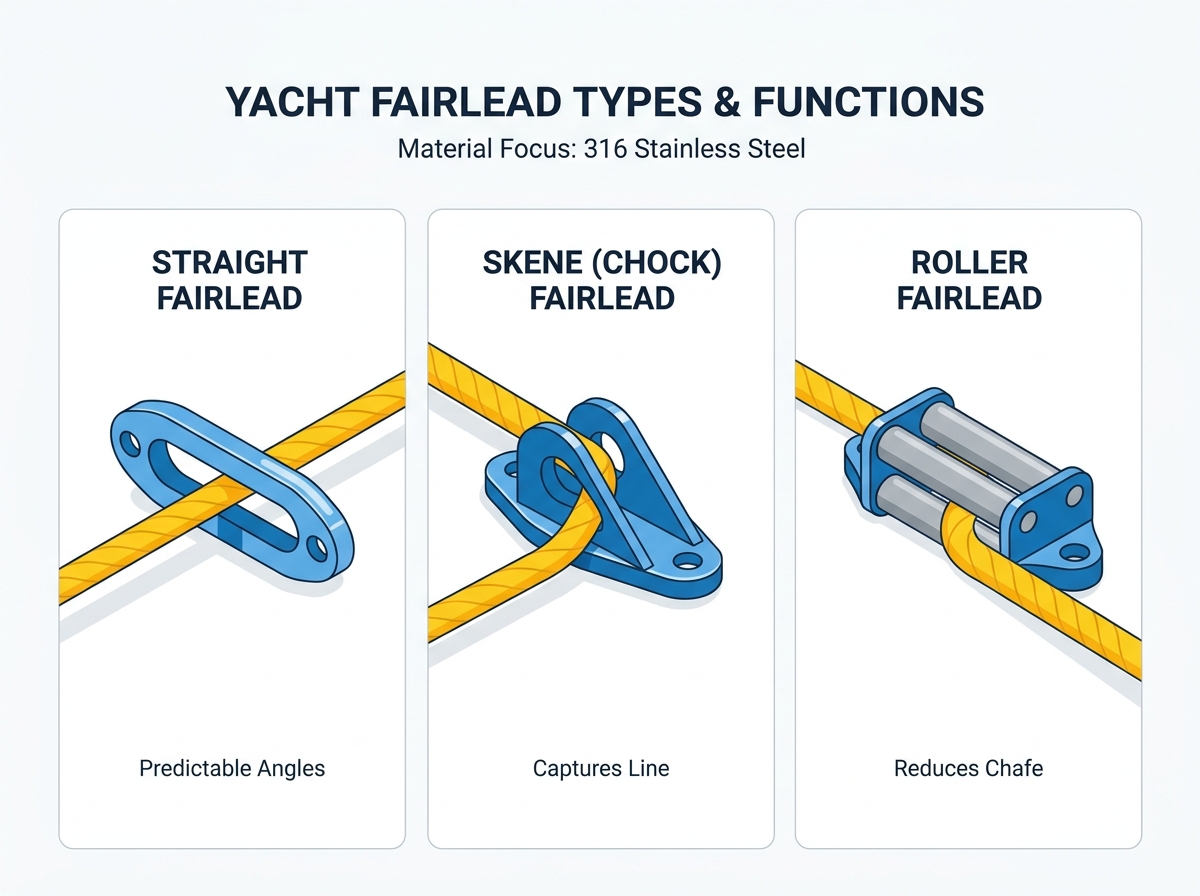
Standard fairleads feature a simple, symmetrical opening. We recommend these for straightforward, straight-line tension applications. They perform perfectly when dock angles remain highly predictable. If you tie up in a fixed slip with minimal tidal variation, a straight design works flawlessly. They offer clean aesthetics and zero moving parts.
Skene (Chock) Designs
Tidal shifts completely alter mooring dynamics. As the water drops, the dock line pulls aggressively downward. A standard open chock might allow the line to pop out. Skene fairleads solve this through an asymmetrical "left/right" design. The overlapping metal horns capture the rope securely. We frame this as the standard yacht fairlead solution for tidal waters. The captured design keeps lines safely retained regardless of vertical hull movement.
Roller Bearing Variations
Heavy-displacement vessels generate immense friction on static chocks. Roller fairleads feature rotating horizontal or vertical cylinders. We evaluate these for massive yachts or scenarios requiring frequent line adjustments. Canal transits and high-load anchorages demand this hardware. The spinning rollers reduce line chafe to near zero. They allow thick lines to slide effortlessly under immense tension. However, they introduce mechanical complexity. You must lubricate the bearings regularly to prevent seizure.
Alternative Routing Solutions
Some vessels lack traditional flat toe rails. Bulwark-mounted chocks pass directly through the raised hull sides. This keeps the deck entirely clear of trip hazards. Alternatively, you might need to route spring lines over a raised railing. You can utilize specific yacht rail fittings to redirect these lines safely. Rail-mounted blocks keep lines elevated and prevent them from dragging across delicate woodwork.
Comparison of Fairlead Types
| Hardware Type | Primary Use Case | Friction Level | Maintenance Need |
| Straight / Standard | Predictable, fixed-slip docking | Moderate | Very Low |
| Skene (Chock) | Tidal areas, vertical line shifts | Moderate | Very Low |
| Roller Design | Heavy displacement, canal transits | Very Low | High (Lubrication) |
| Bulwark Mounted | Clear deck requirements | Moderate | Low |
Sizing, Load Capacity, and Technical Specifications
Selecting the wrong size hardware invites immediate failure. The geometry of the chock must match your specific rigging choices. Proper sizing requires basic mathematical clearances.
Matching Hardware to Line Diameter
You need a precise framework for physical sizing. Nylon mooring lines swell significantly when saturated with saltwater. The internal radius of the fairlead must easily accommodate this expanded diameter. It must do so without pinching or binding the rope. Industry best practices dictate a strict rule here. You typically require a minimum 15-20% clearance above the stated rope diameter. A snug fit creates dangerous heat friction under heavy loads.
Evaluating Safe Working Loads (SWL)
Marine engineers separate load ratings into two distinct categories. We must explain the critical difference between Safe Working Load (SWL) and Breaking Strength. Breaking Strength marks the exact point of catastrophic structural destruction. SWL represents the maximum tension for safe daily operations. This is usually 20% to 25% of the breaking limit. Guide your procurement logic carefully here. Match the hardware’s SWL to the vessel’s maximum displacement. Ensure it aligns with the breaking strain of your chosen docking lines.
Structural Deck Considerations
Hardware strength means nothing in a vacuum. Even the strongest yacht fittings and hardware will violently rip out if the deck core is compromised. Water intrusion rots balsa or plywood coring. A rotten core crushes under the clamping force of bolts. You must address this structural necessity directly. Check the deck thickness. Verify core integrity by tapping with a phenolic hammer before beginning procurement. Solid fiberglass sections provide the ideal mounting foundation.
Implementation Guide: Upgrading and Installation Realities
Executing a flawless installation requires practical structural knowledge. Slapping marine sealant on a bolt achieves nothing. You must integrate the hardware into the deck matrix permanently.
Confronting Retrofitting Challenges
Upgrading old hardware rarely goes smoothly. You face the harsh reality of unmatched bolt-hole patterns. Modern hardware footprints rarely align perfectly with vintage castings. You cannot simply drill new holes near the old ones. This creates a perforated, weakened deck section. You must over-drill the original holes. Fill them completely with thickened epoxy resin. Let the epoxy cure fully. You can then map and drill fresh holes into solid, reinforced epoxy plugs.
The Critical Role of Backing Plates
Surface-level fastening guarantees eventual failure. Shock loads act as massive levers against deck bolts. We mandate the absolute use of heavy-duty backing plates. These plates sit under the deck inside the cabin or locker. They distribute extreme lateral and vertical loads across a wider surface area. Use structural G10 fiberglass, thick stainless steel, or heavy aluminum plates. Proper backing prevents catastrophic deck delamination during severe storms.
Shortlisting Logic for Buyers
Follow a strict operational checklist before finalizing your order. This eliminates costly return shipments and project delays.
- Confirm the swollen wet diameter of your primary mooring lines.
- Measure the exact deck footprint restrictions available near the cleats.
- Select marine-grade 316 stainless steel for maximum corrosion resistance.
- Verify physical access to the under-deck area for installing backing plates.
- Calculate the required bolt length to accommodate the deck thickness plus the backing plate.
Conclusion
Reliable mooring demands a holistic engineering approach. You must view your cleats, fairleads, and under-deck backing plates as a single, cohesive structural system. A failure in one component instantly compromises the entire array. Upgrading to purpose-built hardware drastically improves your safety margins at the dock. It simultaneously protects your expensive lines and gelcoat from unnecessary abrasion.
Before placing any orders, execute a final physical verification. Measure your available deck footprint precisely. Double-check your existing mooring line diameters. Physical measurements prevent frustrating installation delays. Next steps are straightforward. We highly encourage consulting a certified marine rigger for complex layouts. Utilize official technical specification sheets to finalize your comprehensive hardware bill of materials. A methodical approach guarantees a permanent, secure installation.
FAQ
Q: What is the difference between a cleat and a fairlead?
A: Cleats serve as the primary anchor point to secure the mooring line firmly to the deck. Fairleads do not secure the line. They guide the rope, alter its trajectory, and manage friction as the line leaves the boat. They work together as a complete load-management system.
Q: Do I need roller fairleads on a standard cruising sailboat?
A: Static chocks (Skene fairleads) are usually perfectly sufficient for standard docking on light to medium cruisers. Rollers are best reserved for heavy-displacement vessels or complex anchor rode management. In those specific scenarios, physical friction becomes exceptionally high and requires mechanical reduction.
Q: Can I mix aluminum cleats with stainless steel yacht fittings?
A: Yes, but you face severe risks of galvanic corrosion in saltwater. If mixing dissimilar metals is unavoidable, you must isolate them. Use dielectric compounds (like Tef-Gel) on the bolt threads. Install specialized plastic or rubber isolating gaskets between the metal surfaces.
Q: How far should a fairlead be positioned from the mooring cleat?
A: The general rule of thumb dictates positioning the fairlead 12 to 24 inches away from the cleat. This specific distance depends on your deck layout. It allows proper line wrapping angles around the cleat base without creating an overly tight, dangerous pinch point.