In the marine industry, hardware failure causes more than a minor inconvenience. It represents a serious liability and a frustrating warranty nightmare. Broken cleats or corroded hinges put vessels and passengers at direct risk. Consequently, procurement teams are shifting away from transactional purchasing toward strategic sourcing. Whether you operate as a boat builder, refitter, or manage a large-scale distribution network, your manufacturer choice remains critical. They dictate your product's longevity. They also safeguard your brand's overall reputation. Poor sourcing leads to premature failure in harsh saltwater environments. This guide serves as a pragmatic, evidence-based framework. It helps you evaluate, audit, and select the right manufacturer. We focus heavily on material science, production capacity, and supply chain reliability. You will learn how to avoid common pitfalls. You can secure a reliable manufacturing partner confidently.
Key Takeaways
Material verification is non-negotiable: True marine-grade suppliers provide traceability for 316/316L stainless steel and marine-grade alloys.
Customization vs. Catalog: The best partners offer both off-the-shelf marine boat hardware accessories and precision OEM custom marine hardware capabilities.
Compliance equals consistency: ISO 9001 certification and standardized quality control (QC) separate true manufacturers from inconsistent middle-men.
The Hidden Costs of Choosing the Wrong Marine Supply & Hardware Partner
Boat manufacturing operates on tight schedules. Delayed shipments stall entire assembly lines. Poorly manufactured parts break under load. A simple broken latch can result in thousands of dollars in warranty claims. You lose customer trust immediately. Sourcing high-quality boat hardware prevents these expensive bottlenecks. Reliable partners keep your production line moving smoothly.
Many suppliers play dangerous games with metallurgy. They falsely label 304 stainless steel as "marine-ready". They substitute inferior alloys to cut costs. These cheaper materials degrade rapidly. They leave ugly rust stains across pristine fiberglass decks. Genuine marine environments demand uncompromising metallurgical standards. You cannot afford to cut corners here.
Supply chain vulnerabilities present another massive risk. Many buyers unknowingly rely on unvetted third-party foundries. You face inconsistent lead times. Product quality fluctuates wildly between production batches. A direct partnership ensures stability. Choosing a dedicated marine supply & hardware partner eliminates unpredictable delays. Direct communication prevents disastrous manufacturing errors.
Core Evaluation Criteria for Boat Hardware Manufacturers
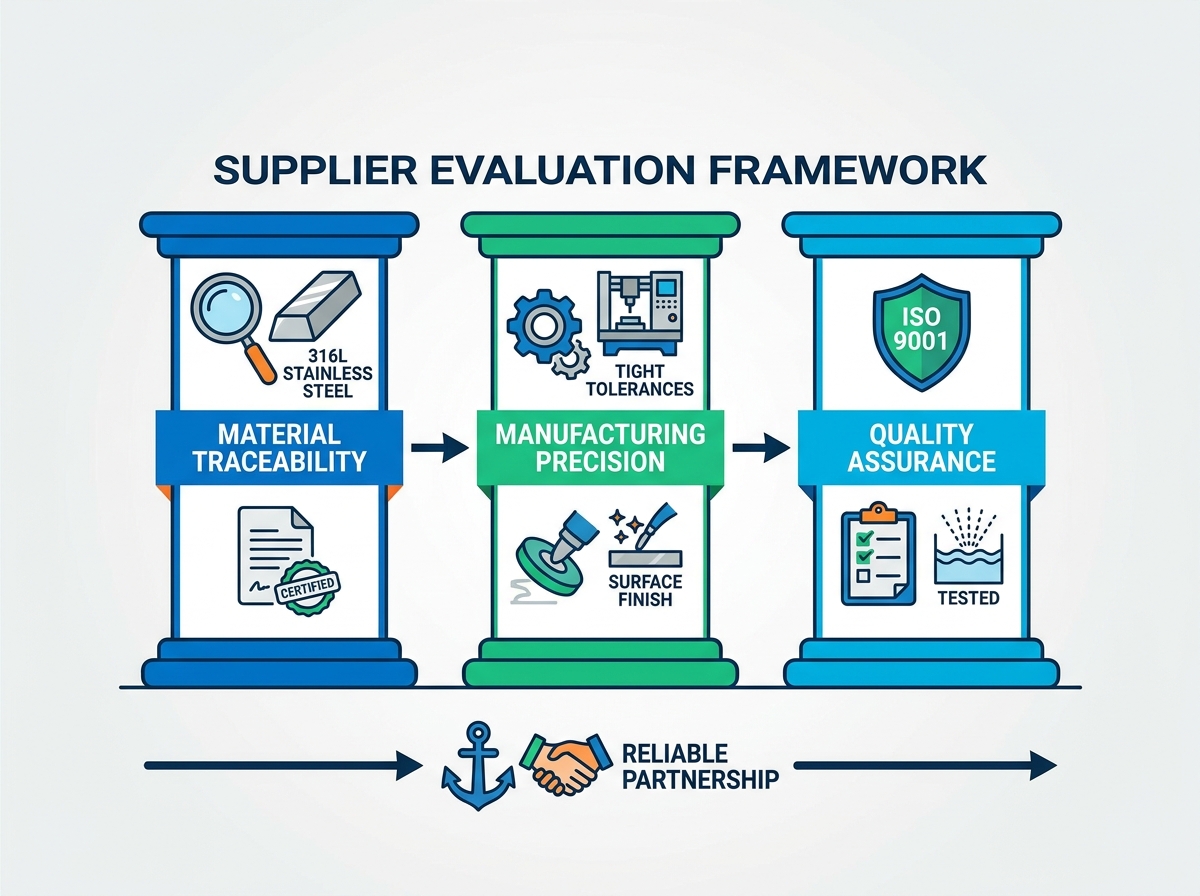
Material Traceability and Metallurgical Standards
Rigorous material testing remains absolutely essential. Manufacturers must perform regular salt spray tests according to ASTM B117 standards. They should use Positive Material Identification (PMI) spectrometry. This verifies exact alloy compositions before casting begins. Suppliers specializing in stainless steel marine hardware must prove their claims visually and technically.
They must use genuine 316 or 316L stainless steel. The "L" indicates lower carbon content. This drastically reduces intergranular corrosion after welding. Alternatively, they should use specific marine-grade aluminum and brass alloys. Proper traceability ensures every batch meets strict industry requirements. Without certified material test reports, you risk rapid structural degradation.
Precision Machining and Finishing Processes
Surface treatments prevent tea-staining. They also stop dangerous crevice corrosion. Basic mechanical polishing often leaves microscopic imperfections. These tiny pits trap corrosive salt particles. Superior manufacturers employ electropolishing and chemical passivation. These advanced processes remove surface iron impurities entirely. They create a passive chromium-oxide layer.
This finishing process dramatically extends hardware lifespans. Machining tolerances are equally critical. High-load environments demand absolute precision. Rigging components, cleats, and hinges endure immense physical stress daily. Precise thread tolerances prevent mechanical failure under heavy dynamic loads. Poorly machined threads seize up quickly in marine environments.
Factory Certifications and Quality Assurance
Legitimate manufacturers maintain strict ISO 9001 compliance. Many also adhere to CE or ABYC manufacturing standards. A rigorous Quality Control (QC) process separates top-tier factories from average workshops. Relying solely on final inspections often leads to missed internal defects.
An optimal QC framework includes several mandatory stages:
Incoming material inspection verifies raw alloy ingots before melting.
In-line inspection catches dimensional defects during active production.
Final random inspection ensures bulk compliance before shipping containers load.
You must ask potential suppliers for their standard inspection checklists.
Standard Catalog vs. Custom Marine Hardware Capabilities
Assessing the Standard Line
Evaluate the supplier's breadth of standard products carefully. Look closely at their deck hardware. Examine their cabin fittings and rail mounts. A diverse, readily available catalog indicates strong baseline production capacity. Robust standard lines show they handle consistent production volumes well. You can source reliable marine boat hardware accessories quickly. Broad catalogs also suggest they keep well-maintained molds in stock. This drastically reduces your turnaround times for standard components.
Evaluating OEM/Custom Capabilities
Many modern vessels require specialized parts. Custom marine hardware demands advanced engineering support. You must evaluate tooling costs carefully. Assess their 3D prototyping abilities. Solid CAD/CAM software integration is crucial for precise manufacturing. Strong engineering teams translate your sketches into workable technical files smoothly.
Custom Hardware Lifecycle Phases
Phase
Objective
Key Deliverable
Technical Drawing
Define exact dimensions and tolerances
Approved CAD/CAM Files
Tooling & Mold Creation
Fabricate precise investment casting molds
Initial Tooling Set
Prototyping
Verify physical dimensions and finish
Physical Sample (First Article)
Mass Production
Scale output while maintaining consistency
Bulk Shipment
Scalability
How easily can the manufacturer scale production? They must handle small batches of custom fittings efficiently. They must also supply a full fleet production line seamlessly. This flexibility ensures they grow alongside your business. A rigid supplier stunts your growth. A flexible partner adapts to market demands instantly.
Logistics, Lead Times, and After-Sales Support
Implementation Realities
Global shipping logistics impact your operations directly. Minimum order quantities (MOQs) affect cash flow heavily. They also impact inventory management strategies. Extremely high MOQs tie up your working capital unnecessarily. Very low MOQs might increase per-unit shipping costs dramatically. Balancing these factors requires a highly transparent manufacturing partner. Reliable suppliers provide accurate forecasting. They update you on port delays proactively.
Communication & Responsiveness
Evaluate the manufacturer’s technical support thoroughly. Do they employ dedicated engineers? Do these engineers understand harsh marine environments? Or do they just rely on standard sales representatives? Direct access to engineers prevents costly miscommunications. Language barriers often complicate technical discussions. Strong partners provide clear, responsive technical liaisons.
Warranty and Defect Resolution
Define a reliable return policy early. Establish clear replacement procedures for structural failures. Finish defects require immediate, hassle-free resolution. A strong warranty policy shows confidence in their internal manufacturing process. Using a trusted marine supply and hardware provider ensures better post-sale protection. They should replace defective parts without extended arguments.
Red Flags to Watch for When Auditing a Marine Supply Hardware Factory
Lack of In-House Testing
Some suppliers cannot provide in-house tensile strength reports. They might lack basic corrosion resistance test equipment. This strongly indicates poor internal quality control. If they outsource all testing, they lose direct oversight. Genuine manufacturers own spectrometers. They own salt spray chambers. They test batches continuously.
Evasive Supply Chains
Ask exactly where casting operations take place. Request the physical address of the foundry. An inability to pinpoint these locations is a massive red flag. It usually indicates they operate as a mere broker. Brokers pose as manufacturers to increase margins. They cannot guarantee consistent quality across batches. True factories welcome site visits openly.
Inconsistent Tooling Maintenance
Request random sample batches before signing large contracts. Inspect these parts under strong lighting. Look for high flash marks. Check for inconsistent polishing across the surface. Dimensional variations in sample batches reveal poor tooling maintenance. Worn molds produce sloppy parts. You need a marine supply hardware partner dedicated to strict tooling upkeep.
Conclusion
Choosing a top-tier supplier requires careful balancing. You must weigh material integrity against overall manufacturing capability. Logistical reliability is equally paramount.
Procurement teams should start by requesting strict material certificates. Always demand physical sample batches first. Do this before committing to high-volume contracts.
Focus on verifiable standards rather than just low prices. Cheap parts always fail early.
Reach out to potential partners today. Send specific technical drawings. Request a comprehensive audit of their quality control documentation immediately.
FAQ
Q: What is the difference between 304 and 316 stainless steel in marine hardware?
A: The primary difference lies in their chemical composition. Type 316 stainless steel contains molybdenum. This specific addition drastically improves its resistance to pitting. It prevents chloride-induced corrosion effectively. Type 304 lacks this element entirely. It remains highly susceptible to rusting in harsh saltwater environments. Always specify 316 or 316L for exterior marine applications.
Q: How do I verify the quality of custom marine hardware before bulk ordering?
A: Verifying quality requires a strict multi-step approach. You should always request first-article inspection (FAI) reports. Demand official metallurgical certificates to confirm proper alloy composition. Finally, conduct physical sample testing yourself. Real-world salt spray tests ensure maximum durability. Load-bearing tests verify the hardware meets your strict operational requirements safely.
Q: Are standard marine boat hardware accessories interchangeable between suppliers?
A: Standard components often appear interchangeable at first glance. Generic hole patterns frequently match industry norms. However, actual load ratings vary wildly between different factories. Thread tolerances also differ significantly. You cannot safely swap high-load components without proper engineering verification. Physical testing remains absolutely required before substituting one supplier's hardware for another.
Q: What is a standard MOQ (Minimum Order Quantity) for OEM boat hardware?
A: Standard MOQs vary based on the specific manufacturing method. Investment casting typically requires higher minimums. This offsets initial mold setup costs. CNC machining allows for smaller, more precise production runs. Generally, you can expect OEM requirements to range from 100 to 500 units. This depends entirely on the part's overall complexity and weight.