Hardware failure in rigging does not just compromise your race or casual cruise. It risks catastrophic dismasting and introduces massive safety hazards. The ocean environment relentlessly tests every pin, terminal, and wire on your vessel. A polished exterior often hides deep structural weaknesses. We position this guide specifically for boat owners, refit project managers, and marine technicians. You are actively evaluating hardware for crucial upgrades or structural replacements. You face real physical threats if inferior components fail under dynamic loads. Selecting the right yacht fittings requires looking far beyond aesthetic finishes. You must meticulously evaluate metallurgical integrity, Safe Working Loads (SWL), and specific functional compatibility. This comprehensive guide breaks down exactly how to match hardware to your vessel's unique rig design. We will explore how to separate marketing fluff from verifiable marine reality.
Key Takeaways
- Load Specifications Over Aesthetics: Always evaluate hardware based on Safe Working Load (SWL) and breaking strength rather than standard "marine-grade" marketing labels.
- Component Compatibility: Mixing metals or combining legacy wire hardware with modern synthetic rigging introduces severe friction and galvanic corrosion risks.
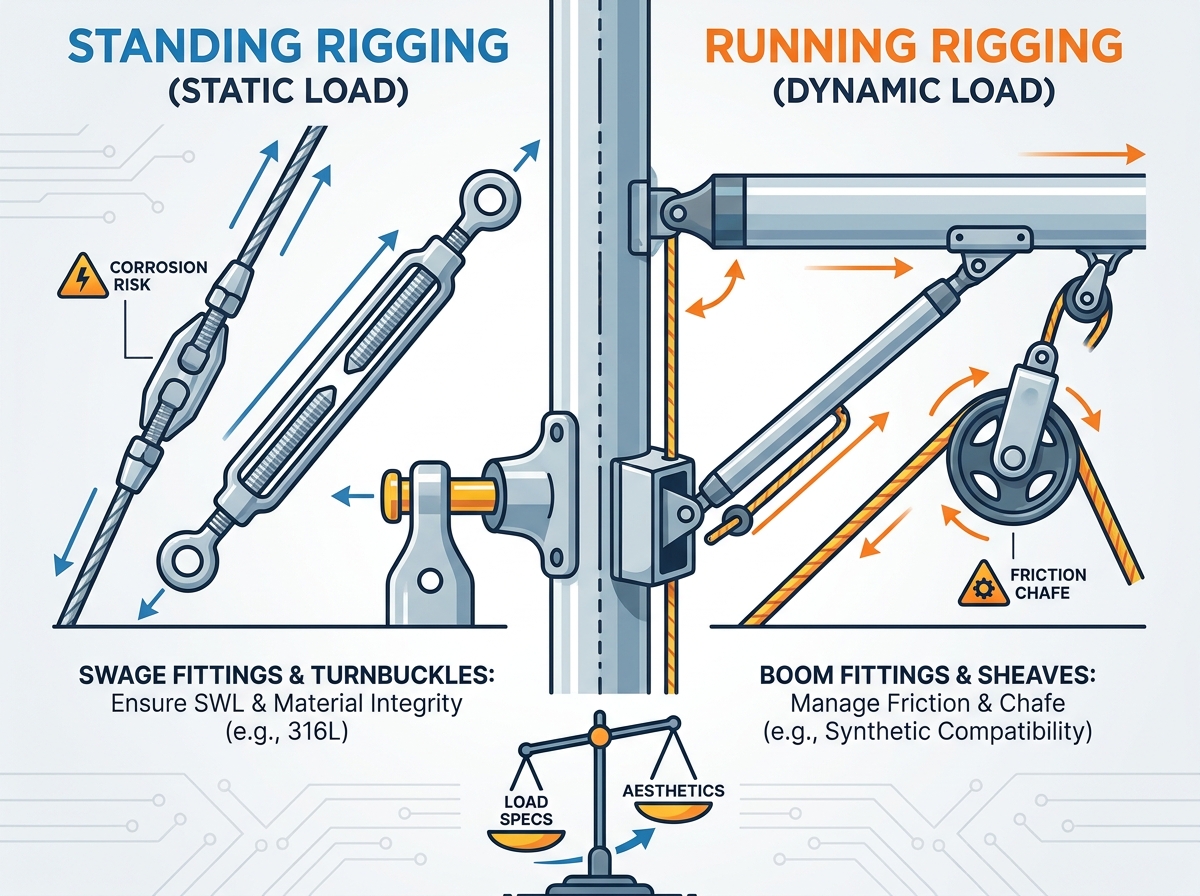
- Rigging Classification Matters: Standing rigging demands static load reliability (swages, turnbuckles), while running rigging hardware must minimize dynamic friction (sheaves, boom fittings).
- Verification is Crucial: Procurement should rely on batch-tested, certified components with verifiable alloy standards (e.g., 316L, Duplex stainless).
Framing the Decision: Quality Metrics for Yacht Rigging Fittings
The marine hardware market frequently masks low-quality manufacturing behind shiny polishing. Cheap hardware carries severe hidden costs. Crevice corrosion destroys inferior steel from the inside out. Premature metal fatigue occurs invisibly under the surface. When a single terminal fails, the cascading financial impact is immense. You lose the rig, damage the deck, and potentially tear expensive sails. We must evaluate hardware based on engineering metrics, not appearances.
Load ratings serve as your primary evaluation dimension. You must clearly differentiate between Breaking Load (BL) and Safe Working Load (SWL). Breaking Load indicates the absolute peak force required to physically destroy the component. Safe Working Load represents the maximum continuous tension the part safely handles over time. Rigging systems are only as strong as their weakest pin or terminal. If you buy oversized wire but use an undersized clevis pin, the entire system adopts the lower rating.
You must adopt a highly skeptical approach to generic "corrosion-resistant" claims. Many manufacturers stamp "marine-grade" on products without verifying the alloy content. Buyers must demand exact alloy specifications. Reliable yacht rigging fittings come with proof-loading data from reputable foundries. Trusting superficial polishing over metallurgical testing is a dangerous mistake.
Table 1: Breaking Load (BL) vs. Safe Working Load (SWL) Application Rules
| Metric | Definition | Typical Safety Margin | Application Context |
| Breaking Load (BL) | The exact force at which hardware structurally fails or permanently deforms. | Used as a baseline to calculate SWL. | Never use BL as a daily operational target. It represents catastrophic failure. |
| Safe Working Load (SWL) | The maximum recommended static or dynamic load for continuous safe use. | Typically 20% to 40% of the Breaking Load. | Use SWL to match components. All pieces in a system must share a similar SWL. |
Best Practices for Load Evaluation: Always size your hardware based on the SWL. Ask suppliers for batch testing certificates. If a supplier cannot provide destruction test data, find another vendor.
![Yacht Rigging Hardware Setup]()
Standing Rigging Components: Securing the Mast
Standing rigging components bear the massive responsibility of static, high-load tensioning. They keep the spar upright against the immense leverage of the wind. Failure here is catastrophic.
Sailboat Swage Fittings & Terminals
Connecting wire rope to hardware requires specific terminal strategies. We evaluate two main options: swaged terminals and mechanical terminals. Machine swaging utilizes a hydraulic press to cold-forge the metal sleeve directly onto the wire. It provides a sleek, permanent connection. However, machine swaging introduces significant implementation risks. The process is permanent. Micro-fractures can occur during pressing. If not properly sealed, saltwater enters the tiny gaps between the wire and the fitting. This traps moisture and initiates hidden internal crevice corrosion.
Mechanical (friction or cone) terminals offer a safer alternative for offshore cruisers. You can inspect them in the field. You can rebuild them using basic hand tools. These mechanical sailboat swage fittings require precise initial torque during installation. If you fail to seat the internal cone correctly, the wire will pull out under heavy loads.
Common Mistakes: Covering swage fittings with heat-shrink tubing. This traps saltwater against the metal. It actively starves the stainless steel of oxygen, rapidly accelerating crevice corrosion.
Turnbuckle Sailboat Essentials
Turnbuckles provide the mechanical advantage necessary to properly tension the rig. You must choose between open-body and closed-body designs. We strongly frame open-body models as the industry standard for serious buyers. An open-body turnbuckle sailboat setup allows instant visual inspection of thread engagement. You can easily spot broken wire strands. You can effectively flush out salt crystals with a hose.
Risk mitigation is crucial here. Closed-body turnbuckles trap salt, grit, and moisture. This leads to thread galling, which is a form of cold welding. When stainless steel threads rub together under massive load, friction strips the protective oxide layer. The metals fuse together instantly. To prevent this, you need dissimilar metal threads. Using a bronze turnbuckle body with stainless steel threaded screws dramatically increases longevity. The bronze acts as a natural bearing surface, completely eliminating the galling risk.
Sailboat Mast Fittings & Tangs
Securing the wire to the mast requires specialized hardware. We must carefully assess hound fittings, mast tangs, and spreader bases. These components face immense shear loads. The mast pulls forward while the shrouds pull backward. The connection points endure intense, focused stress.
Evaluating sailboat mast fittings requires strict attention to pin-hole tolerances. The clevis pin must fit the tang hole exactly. If the hole is slightly oversized, the pin will rattle. This creates point-loading. Point-loading concentrates hundreds of pounds of force onto a tiny surface area. It causes the metal hole to elongate over time. Eventually, the tang shears off completely. Always measure chainplate and tang thicknesses to ensure the toggles articulate smoothly without binding.
Running Rigging & Spar Hardware: Dynamic Load Management
Running rigging hardware manages the active control of sails and boom articulation. These components experience constant movement, friction, and dynamic shock loads.
Sailboat Boom Fittings
The boom acts as a massive lever. It transfers wind energy directly into the mast and mainsheet systems. Goosenecks, rigid vangs, and outhaul cars face multi-directional dynamic loads. They twist, pull, and compress simultaneously.
Implementation requires evaluating bushing materials carefully. Stainless steel grinding against aluminum destroys the softer metal quickly. High-quality sailboat boom fittings utilize advanced plastics like Torlon or Delrin for bushings and bearings. These materials offer exceptional wear resistance under high compression. You must actively inspect articulating joints. Worn toggles cause sloppy movement. Replace them immediately before they permanently elongate the boom brackets. A ten-dollar toggle replacement saves a thousand-dollar boom extrusion.
Yacht Mast Fittings for Running Systems
Managing halyards and control lines requires frictionless pathways. We evaluate halyard exit boxes, masthead sheaves, and spinnaker pole tracks based on their rolling efficiency. High friction makes hoisting sails exhausting. It also accelerates line wear.
Scalability becomes critical when transitioning to modern synthetic rigging like Dyneema or Kevlar. Note the operational reality: synthetic lines behave entirely differently than traditional wire. Synthetic rope requires specific bending radii to maintain its breaking strength. It demands perfectly frictionless, U-shaped surfaces to prevent dangerous chafe. Legacy wire-based sheaves use V-shaped grooves. These old grooves will actively pinch and shred expensive synthetic lines. Upgrading your running rigging renders older yacht mast fittings obsolete. You must replace them with specialized synthetic-friendly sheaves.
Material Integrity and Galvanic Corrosion Risks
Selecting the right alloy dictates the lifespan of your rigging. Material science plays a dominant role in marine hardware survivability.
Evaluation Dimension for Materials:
- 316 and 316L Stainless Steel: This represents the baseline industry standard. The "L" stands for low carbon, which improves welding characteristics. However, 316L remains highly susceptible to oxygen starvation. Stainless steel relies on a microscopic chromium oxide layer to prevent rust. If stagnant saltwater blocks oxygen from reaching the metal, crevice corrosion destroys the fitting rapidly.
- Duplex Stainless Steel: A high-end alternative offering superior yield strength. It resists chloride stress corrosion cracking far better than 316L. It is ideal for critical structural pins.
- Titanium: The ultimate choice for offshore or grand-prix racing applications. Titanium provides massive weight reduction aloft. It offers extreme, near-total immunity to saltwater corrosion.
Table 2: Material Performance Comparison Chart
| Material Type | Corrosion Resistance | Strength-to-Weight | Primary Application |
| 316L Stainless Steel | Moderate (requires oxygen) | Standard | General rigging, turnbuckles, standard pins. |
| Duplex Stainless | High | High | High-load structural pins, custom tangs. |
| Titanium Grade 5 | Extreme | Very High | Racing applications, weight-critical masthead components. |
Implementation Reality: You must ruthlessly manage the risk of galvanic corrosion. Dissimilar metals submerged in an electrolyte (saltwater) create a battery. The less noble metal always sacrifices itself. If you mix carbon fiber spars, aluminum masts, and stainless steel hardware without protection, destruction follows. Carbon fiber acts incredibly nobly. It will rapidly corrode stainless steel in direct contact. You must provide proper dielectric isolation. Use compounds like Tef-Gel or Duralac. Install nylon isolation pads beneath all stainless hardware mounted on aluminum masts.
Specifying Your Setup: Shortlisting Logic & Next Steps
Buying hardware requires precise data. Guesswork leads to catastrophic failures or expensive return shipping. You need a rigorous shortlisting framework to conduct a pre-purchase rig audit.
Step-by-Step Rig Audit:
- Pin-to-Pin Measurements: Never guess lengths based on boat models. Rigs stretch, and previous owners make modifications. Measure exactly from the center of the upper pin to the center of the lower pin using a calibrated tape.
- Pin Diameter Verification: Measure every single clevis pin with digital calipers. Verify these dimensions against your chainplates. Tolerances must be exact. There is no "close enough" in rigging. A 5/8-inch pin in a 16mm hole creates dangerous point-loading.
- Thread Specification Matching: Confirm whether your existing turnbuckles use Metric or Imperial threads. Mixing them destroys the turnbuckle body immediately upon tensioning. Determine if the threads are left-handed or right-handed.
Procurement Advice: The marine market suffers from counterfeit structural hardware. Unbranded stainless steel parts bought from generic online marketplaces carry unknown metallurgical origins. You must avoid unbranded hardware entirely. The necessity of buying from dedicated suppliers cannot be overstated. Demand mill certificates. Ensure batch traceability is etched directly onto the metal components.
Next Step Action: Stop relying on visual inspections alone. Grab a set of digital calipers and document your current rig specifications today. Measure pin diameters accurately. Once you compile your data, consult with a certified rigger or our technical sales team. They will analyze your numbers and provide a custom hardware quote designed specifically for your vessel's loads.
Conclusion
Functional reliability in any rigging system is never an accident. It is the direct product of exact specifications, verifiable materials, and correct installation procedures. Upgrading your hardware ensures your vessel handles dynamic loads safely, keeping your crew secure during extreme weather events.
We strongly encourage buyers to prioritize long-term safety and performance over upfront savings. Cheap components will inevitably cost you a mast. Do not compromise on the structural integrity of your vessel. We invite you to direct your attention to the contact page or browse our catalog. Submit your precise refit specifications today for a comprehensive technical review by our rigging experts.
FAQ
Q: How often should I replace sailboat swage fittings?
A: Industry standards dictate replacing stainless wire rigging every 10 to 12 years in saltwater environments. You must replace them regardless of their visual appearance. Metal fatigue and hidden crevice corrosion develop internally, meaning catastrophic failure can occur without any outward signs of rust or cracking.
Q: Can I use my existing wire sheaves when upgrading to synthetic running rigging?
A: Usually, no. Wire sheaves feature a narrow, V-shaped groove designed to support steel strands. Synthetic lines like Dyneema require a wider, perfectly smooth, U-shaped profile. Using old wire sheaves will pinch, flatten, and rapidly chafe expensive synthetic lines, leading to premature breaking.
Q: What is the difference between marine-grade stainless and 316L?
A: "Marine-grade" is an unregulated, generic marketing term that guarantees nothing about the metal's actual composition. 316L is a specific, verifiable metallurgical grade. It dictates exact percentages of chromium, nickel, and molybdenum, ensuring predictable corrosion resistance and structural strength in harsh saltwater environments.
Q: Why is my closed-body turnbuckle seized?
A: Your turnbuckle likely suffered from thread galling. When stainless steel threads experience high tension without lubrication, friction strips their protective oxide layer. The metals literally cold-weld together. This reinforces our recommendation for open-body turnbuckles utilizing dissimilar metals, like bronze bodies with stainless screws, to prevent seizing.