Stepping onto a moving deck in rough seas tests more than just your balance. It tests the absolute reliability of your marine hardware. Yacht rails and lifelines serve as critical safety infrastructure. They go far beyond mere aesthetic additions. Upgrading these components is rarely an optional maintenance task. Vessel owners usually face the need for replacement due to visible corrosion, dangerous structural play, failing to meet updated safety regulations, or undertaking major rigging upgrades. Ignoring these early warning signs invites catastrophic failures offshore.
This guide delivers a technical, compliance-aware framework tailored for serious boaters. You will learn exactly how to evaluate, select, and install marine-grade hardware effectively. We break down regulatory compliance, structural demands, advanced material standards, and practical installation realities. By understanding these core principles, you ensure your vessel remains safe, seaworthy, and ready for offshore challenges. Choosing the right yacht fittings ultimately dictates your ability to keep crew members securely on board.
Key Takeaways
- Hardware must meet or exceed specific marine safety standards (e.g., eCFR Title 46 for passenger vessels or offshore racing rules) for height and static load capacity.
- Type 316 stainless steel remains the industry baseline for corrosion resistance, though proper alloy sourcing is critical to avoid crevice corrosion.
- Replacing a single fitting often uncovers systemic weaknesses; thorough deck core and backing plate inspections are mandatory during upgrades.
- Precise measurement of existing tubing (typically 7/8" or 1") and base angles is required to ensure secure, structural integration without metal fatigue.
Regulatory & Safety Standards for Yacht Rail Fittings
Visual inspections rarely tell the whole story. You cannot rely solely on a quick glance to verify hardware integrity. Microscopic crevice corrosion often compromises load capacity long before you see any surface damage. Stainless steel requires oxygen to maintain its protective chromium oxide layer. When moisture gets trapped under washers or inside base tubes, oxygen starvation occurs. This hidden chemical reaction eats away at the structural core. By the time rust streaks appear, the metal has already lost significant strength.
You must align your yacht rail fittings with established compliance frameworks. Authorities like the eCFR (Title 46 for passenger vessels) and World Sailing Offshore Special Regulations dictate strict baselines. For offshore racing, lifelines generally require a minimum height of 600mm (about 24 inches). Regulations also specify maximum deflection limits under static loads. Wire spacing and stanchion intervals must meet rigid guidelines to prevent crew members from slipping through gaps during severe knockdowns. Following these frameworks guarantees safety rather than just ticking a bureaucratic box.
Identifying failure indicators requires objective criteria. You must immediately replace hardware if you observe specific warning signs. Watch for these critical red flags during your pre-season checks:
- Weeping rust streaks: Brown stains trailing from bases indicate internal fastening decay.
- Hairline fractures: Look closely at weld points where the base plate meets the vertical tube.
- Horizontal play: Any lateral movement at the deck base suggests backing plate compression or bolt shear.
- Distorted tubing: Bends or creases in the railing compromise its longitudinal strength.
Core Categories of Boat Railing Accessories
Marine railings rely on highly specific sizing standards. You must differentiate between 7/8-inch and 1-inch tubing before purchasing replacement parts. Coastal cruisers often use 7/8-inch tubing. It handles moderate loads well and reduces top-side weight. However, offshore applications demand 1-inch tubing. The larger diameter significantly increases resistance to bending forces. Wall thickness also matters immensely. A standard .049-inch wall might suffice for inland lakes. Serious offshore vessels require .065-inch wall thickness to withstand heavy crew impacts.
Choosing the right boat railing accessories involves deciding between modular and custom-welded configurations. Modular fittings offer incredible flexibility. You use tees, elbows, and bimini top joints secured with set screws. If a single section bends during a hard docking, you simply unbolt and replace it. Custom-welded rails provide absolute rigidity. They eliminate set screws and moving parts. This seamless construction creates superior strength. However, repairing welded systems requires cutting, re-welding, and polishing by a skilled fabricator.
System Comparison: Modular vs. Welded Rails
| Feature | Modular Fittings | Custom Welded Rails |
| Flexibility | High. Easy to adjust or expand. | Low. Fixed structural design. |
| Maintenance | Requires checking set screws annually. | Virtually maintenance-free. |
| Replacement | Fast. Swap individual parts. | Complex. Requires professional fabrication. |
| Rigidity | Moderate. Minor flex under heavy load. | Maximum. Solid structural unity. |
Hinges and boarding gates demand special attention. These access points introduce inherent weak links into a continuous rail system. You must define strict security mechanisms for boarding gates. Look for dual-locking designs. A primary latch handles everyday closure, while a secondary locking pin prevents accidental opening. Crew members regularly lean their full body weight against these gates. A single-latch failure in heavy seas can lead to a man-overboard emergency. Always prioritize heavy-duty, cast-metal gate hinges over lightweight stamped alternatives.
![Sailboat Lifeline Stanchions and Bases]()
Assessing Sailboat Lifeline Stanchions & Bases
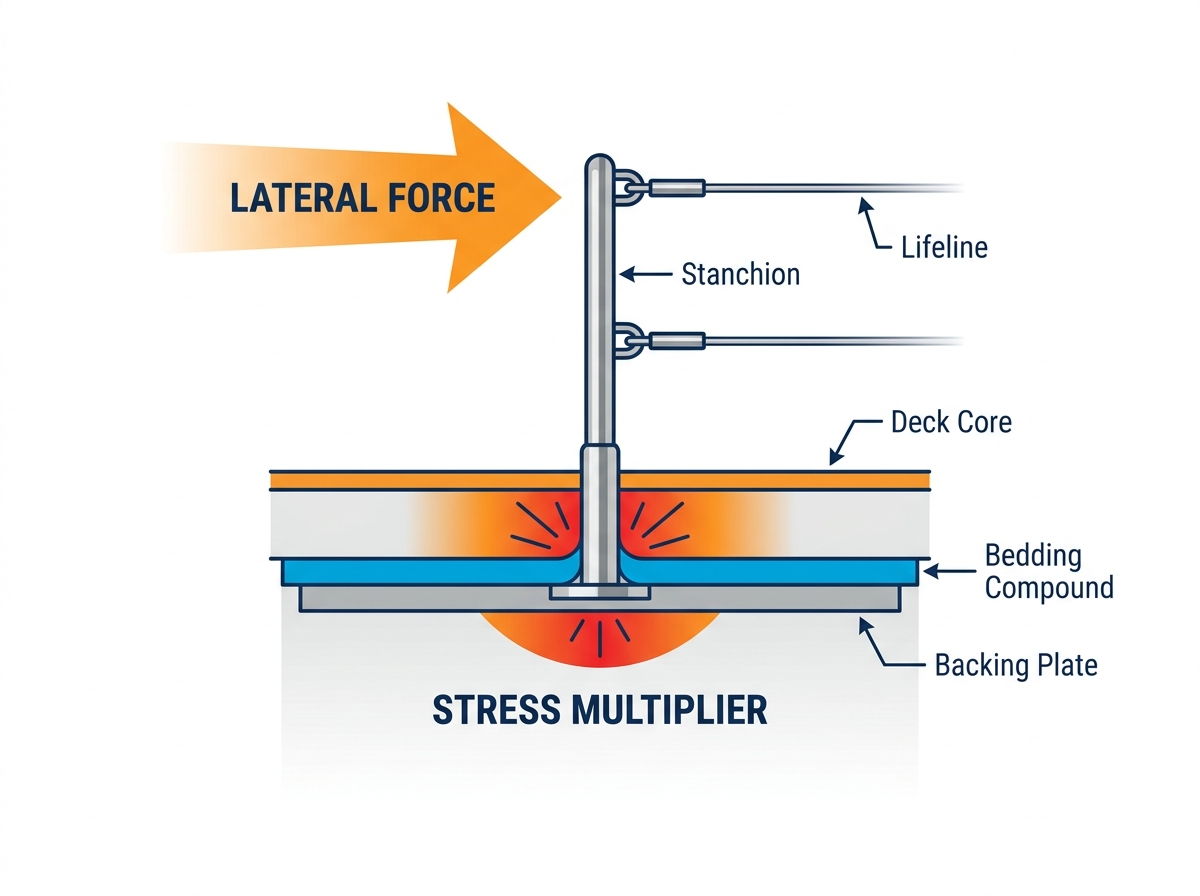
You must understand the immense structural demands placed on lifeline supports. Frame the entire setup as a rigid lever. When a falling crew member strikes the top wire, they apply lateral force. This force travels down the vertical tube and multiplies dramatically at the deck base. A 24-inch stanchion acts like a pry bar against your deck. Installing robust sailboat lifeline stanchions prevents this leveraged force from tearing through the fiberglass laminate. The base must absorb and distribute this concentrated shock load across a wide surface area.
Stanchion base configurations vary based on deck design. You will encounter flat bases, angled bases, and toe-rail mounted options. Flat bases sit flush on level decking. Angled bases accommodate sloped side decks. Toe-rail mounts attach directly to aluminum extrusions at the hull-to-deck joint. You must match the deck camber precisely when installing a stanchion yacht setup. If you force a flat base onto a curved deck, you load the mounting bolts under severe shear stress. This misalignment causes premature fatigue and inevitable deck leaks.
Lifeline integration dictates hardware compatibility. Traditional systems rely on uncoated 1x19 stainless steel wire. This wire offers tremendous chafe resistance and minimal stretch. However, modern rigging trends favor synthetic alternatives. Ultra-high-molecular-weight polyethylene (like Dyneema) provides equal strength at a fraction of the weight. If you upgrade to synthetics, you must modify your stanchions. Dyneema requires perfectly smooth fairleads. Any burr inside the stanchion hole will slice the synthetic fibers under load. You must install dedicated chafe guards or low-friction ferrules to protect these modern lines.
Material Selection for Yacht Guardrail Fittings
Type 316 stainless steel remains the absolute industry standard. You should never accept 304 stainless for deck-level hardware. While 304 resists fresh water adequately, it fails miserably in marine environments. Selecting yacht guardrail fittings requires understanding metallurgy. The secret lies in molybdenum. Manufacturers add this element to create 316L stainless steel. Molybdenum specifically prevents chloride pitting. Saltwater spray constantly coats your rails with corrosive chlorides. Without molybdenum, microscopic pits form instantly, turning shiny hardware into rusty, weakened hazards.
Legacy materials still exist but carry heavy drawbacks. Bronze fittings offer excellent corrosion resistance and a classic nautical aesthetic. However, they oxidize into a green patina unless you polish them relentlessly. Chrome-plated brass represents an even riskier choice. The chrome finish looks spectacular in the showroom. Yet, once salt penetrates a tiny scratch, the underlying brass dezincifies. The fitting becomes brittle and fractures suddenly. You should completely avoid chrome-plated brass for any primary structural guardrails.
Synthetic rigging trends continue reshaping lifeline material choices. Ultra-high-molecular-weight polyethylene (UHMWPE) dominates the high-performance sector. It offers incredible advantages. Synthetics remove heavy metal wire from your boat's perimeter, noticeably reducing pitching momentum. They also feel softer against the skin. However, you must contrast these weight savings with practical realities. UV degradation breaks down synthetics over time. Sun exposure weakens the fibers systematically. You must commit to stringent inspection schedules. Experts recommend replacing synthetic lifelines every three to five years, regardless of visual condition.
Installation Realities for Yacht Fittings and Hardware
Proper bedding and sealing dictate the lifespan of your deck. Every bolt hole represents a potential entry point for water. If water penetrates the fiberglass skin, it soaks the balsa or plywood deck core. This causes devastating core rot. You must execute an exact protocol for sealing deck penetrations. Apply high-quality butyl tape or premium marine polyurethane sealants around every bolt shaft. Countersink the fiberglass holes slightly to create a miniature O-ring of sealant. Tighten the nuts firmly, but do not squeeze all the sealant out. Let it cure fully before final torqueing.
Backing plates are a non-negotiable requirement. Washers alone cannot support the immense lever force of a stanchion. You must install oversized backing plates underneath the deck. These plates distribute the localized load across a wider surface area. We strongly recommend using G10 fiberglass epoxy laminate. G10 provides massive structural rigidity without the corrosion risks of metal plates. If you prefer metal, use oversized 316 stainless plates. Proper load distribution prevents gelcoat crazing and stops the deck from flexing dynamically when you step against the rail.
Galvanic isolation preserves your yacht fittings and hardware. When you join dissimilar metals in a saltwater environment, a mild electrical current flows between them. The less noble metal rapidly disintegrates. This galvanic corrosion commonly occurs when mounting stainless steel bases onto aluminum toe rails. You must interrupt this electrical connection to save your hardware. Follow these essential mitigation steps:
- Apply liberal coats of Tef-Gel or similar anti-seize paste to all stainless bolt threads passing through aluminum.
- Insert nylon or Delrin isolation washers under the stainless bolt heads.
- Use precision-cut rubber gaskets between the stainless base plate and the aluminum mounting surface.
- Inspect isolated fittings annually for any white, powdery aluminum oxide buildup.
Conclusion
Evaluating marine hardware functions primarily as an exercise in risk management. Proper component selection directly influences the longevity and safety of your vessel. High-quality 316 stainless steel, heavy-gauge tubing, and meticulous installation methods form a reliable defense against extreme marine conditions. You cannot compromise on these structural foundations.
We advise you to audit your current railing systems immediately. Inspect every base for hidden crevice corrosion, check your stanchions for lateral play, and verify that your backing plates distribute loads effectively. Identify your weak points before the ocean identifies them for you.
Your clear next step involves precise documentation. Consult a technical specification sheet. Measure your existing tube diameters and calculate your deck angles meticulously. Armed with accurate data, you can confidently source components that ensure seamless, structurally sound integration for years to come.
FAQ
Q: How do I determine if my boat needs 7/8" or 1" railing fittings?
A: Use a set of digital calipers to measure the outside diameter of your existing tubing. Place the jaws around the widest part of the unbent pipe. A reading near 22.2mm indicates 7/8-inch tubing, while 25.4mm confirms a 1-inch system. Never guess visually, as the difference is subtle but structurally critical.
Q: Can I mix different grades of stainless steel on my lifelines?
A: No, you should avoid mixing grades. Combining 304 and 316 stainless steel in a wet environment creates a mild galvanic couple. The lower-grade 304 will corrode faster than normal. Additionally, mixing hardware compromises your overall load ratings, creating unpredictable weak links in your safety perimeter.
Q: How often should yacht guardrail fittings be re-bedded?
A: You should re-bed fittings every seven to ten years. However, this timeline accelerates in tropical climates or under heavy offshore usage. Inspect your deck annually. If you notice chalky sealant, hairline gelcoat cracks around the base, or rust streaks, strip the hardware and re-bed it immediately to prevent core rot.
Q: Are Dyneema lifelines legal for offshore cruising?
A: Yes, they are legally acceptable for general cruising. However, official racing bodies like World Sailing have strict mandates regarding Dyneema. They require specific diameters, UV-resistant coatings, and approved splicing techniques. Even if you do not race, following racing standards guarantees your synthetic lines meet maximum offshore safety thresholds.