Selecting marine hardware carries incredibly high stakes for any vessel. Structural failure, rapid water ingress, and insidious galvanic corrosion represent costly and dangerous threats. You simply cannot afford to guess when outfitting a boat. Boat builders and refitters face a persistent, complex dilemma. You must balance the sleek aesthetic appeal and high tensile strength of modern alloys against the proven, long-term saltwater resilience of traditional metals.
Every single hardware decision directly impacts hull integrity and passenger safety. This guide objectively evaluates the metallurgical realities of yacht fittings. We will help you make safety-compliant, structurally sound procurement decisions. You will learn exactly how to match specific materials to their ideal operational zones. By understanding the science behind the metals, you can confidently secure your vessel against the harshest marine environments.
Key Takeaways
- Below the Waterline: Silicon bronze is the undisputed standard due to its immunity to crevice corrosion in oxygen-deprived environments.
- Above the Waterline: 316 marine-grade stainless steel offers superior tensile strength and aesthetics for yacht deck fittings, provided it receives regular oxygen exposure and maintenance.
- Galvanic Reality: Mixing stainless steel and bronze in the same saltwater system without proper isolation guarantees accelerated galvanic corrosion.
- Application Dictates Material: There is no single "best" material; procurement must be based on the specific operational zone (thru-hulls vs. rigging) and vessel type.
The Engineering Realities of Marine Hardware Failures
Inferior hardware leads directly to catastrophic rigging failures. A compromised hull threatens the entire vessel and everyone aboard. We constantly see owners swap vital components to save upfront expenses. Unfortunately, they only face massive structural repair bills later. The marine environment aggressively tests every metal component. When you choose hardware, you make a critical engineering decision. You must anticipate how materials will degrade over decades of severe abuse.
Saltwater acts as a highly conductive electrolyte. When you evaluate hardware, you must look far beyond surface-level tensile strength. You need to deeply understand how metals behave under constant load in corrosive environments. Two distinct threats exist on every boat. Galvanic corrosion destroys dissimilar metals connected in saltwater. Crevice corrosion silently eats away alloys in oxygen-starved zones. These invisible enemies cause the majority of unexpected hardware failures.
A reliable fitting must offer predictable failure modes. The metal should stretch or bend rather than suddenly snap. This crucial deformation gives you visual warnings long before a disaster occurs. Maintenance routines must also remain manageable for the crew. Finally, the chosen components should align smoothly with the vessel’s long-term operational budget. Reliable hardware investments pay dividends through decades of uninterrupted safety.
![Stainless steel and bronze yacht fittings comparison]()
Evaluating Stainless Steel Yacht Fittings (316 Grade)
Marine-grade 316 stainless steel dominates modern boat building. It features a critical addition of molybdenum over standard 304 grade. This specific alloying element dramatically improves pitting resistance in chloride-rich environments. The metallurgical structure makes it exceptionally tough. Most production boats rely heavily on this specific alloy for highly visible deck hardware.
This alloy boasts exceptionally high tensile and yield strength. It provides a sleek, highly polished aesthetic. Builders and designers love it for modern stainless yacht fittings. It performs perfectly on stanchions, cleats, and bow rollers. The superior strength-to-weight ratio allows designers to cast slimmer, more elegant hardware profiles. This reduces overall deck weight while maintaining enormous load-bearing capacities.
However, stainless steel harbors a fatal flaw. The metal relies entirely on a microscopic chromium oxide layer to prevent rust. This passive layer requires constant ambient oxygen to regenerate. In oxygen-deprived environments, this vital defense mechanism breaks down completely. We see this happen under backing plates, inside wet marine plywood, and anywhere below the waterline. The result is rapid, invisible crevice corrosion inside the metal. A seemingly perfect bolt can suddenly shatter under a moderate load.
You must reserve these metals for high-load, above-waterline applications. Ensure fresh water regularly washes the metal. Ambient air exposure keeps the protective oxide layer fully intact.
Common Mistakes with Stainless Steel
- Using inferior 304 grade instead of 316 for external deck hardware.
- Sealing stainless bolts completely inside wet marine plywood.
- Ignoring brown "tea-staining" on load-bearing rigging components.
- Installing stainless thru-hulls below the waterline.
The Case for Bronze Sailboat Fittings (Silicon Bronze)
You must clearly understand the strict distinction between standard brass and true marine bronze. Standard brass contains high levels of zinc. It suffers from rapid dezincification in saltwater, leaving behind a porous, fragile copper shell. Brass remains completely unsuitable for marine use. Silicon Bronze, however, stands as the absolute industry standard for harsh underwater environments.
Silicon bronze delivers unmatched longevity during constant saltwater immersion. It possesses superior malleability. The bronze will typically deform or bend significantly before catastrophically snapping. This provides a crucial visual warning of overload. You can spot a bent chainplate long before the mast comes down. Bronze sailboat fittings provide unparalleled peace of mind for offshore cruisers.
Over time, the metal develops a natural green or brown patina. This oxidized skin actually protects the underlying metal from further degradation. Enthusiasts highly seek these components for classic yacht fittings. Traditional wooden boat restorers demand them for authentic vintage yacht fittings. Historical accuracy and low-maintenance longevity take ultimate priority in these specialized restoration projects.
Deploy silicon bronze confidently for all thru-hull fittings and underwater fastening. It excels as prop shafts, rudders, and structural hardware on traditional wooden hulls. Use it without hesitation on classic fiberglass vessels where safety supersedes a shiny aesthetic.
Head-to-Head Evaluation: Core Decision Dimensions
Tensile Strength & Load Bearing
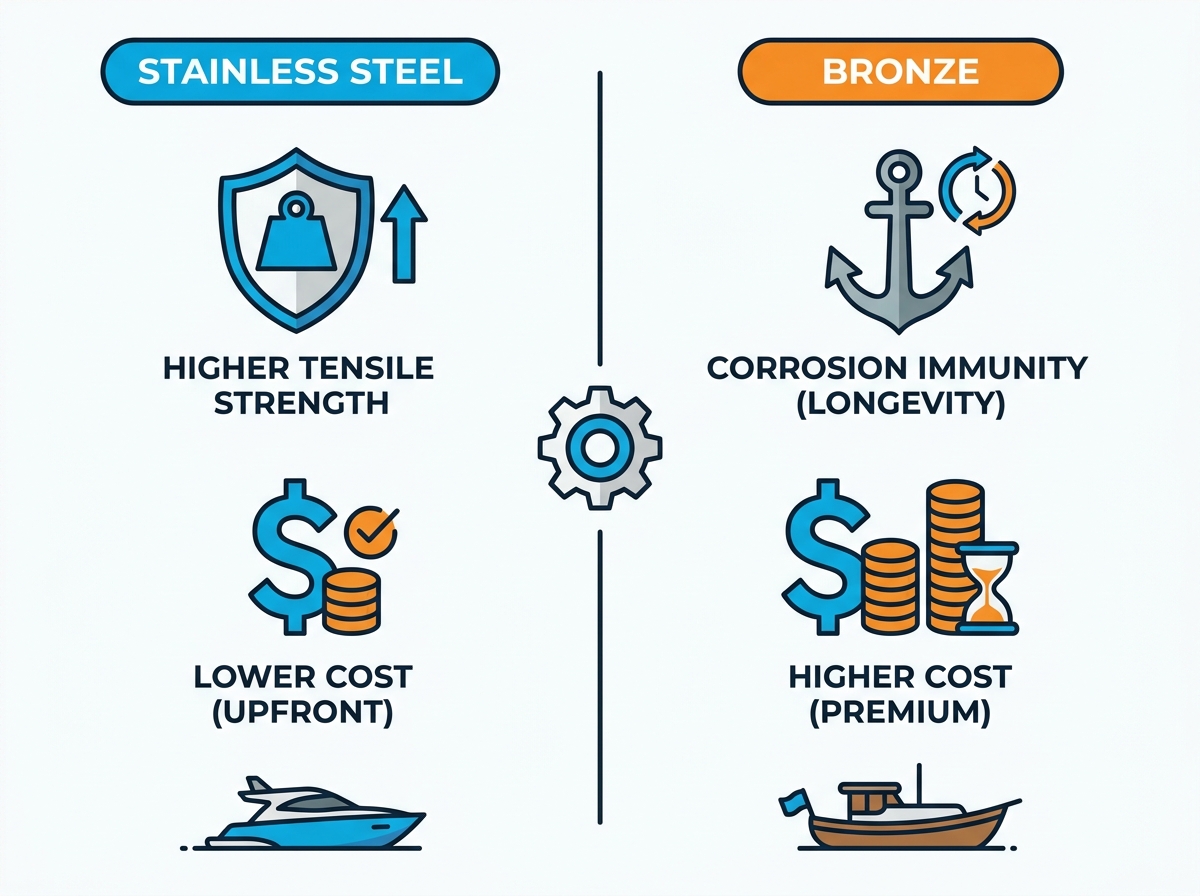
Stainless steel delivers much higher absolute breaking strength. You can safely design smaller, lighter hardware profiles. This appeals heavily to racing yachts where weight reduction matters. Bronze possesses lower overall tensile strength. This physical reality requires bulkier, heavier castings to achieve the same working load limit. However, bronze offers superior shock absorption. It absorbs dynamic shock loads without the severe risk of brittle fracturing.
Corrosion Resistance & Lifespan
Stainless steel remains highly vulnerable to pitting and crevice corrosion. You can expect a reliable lifespan of 15 to 25 years in a marine environment. After this period, microscopic inspection or preemptive replacement becomes absolutely mandatory. Bronze is essentially immune to standard saltwater degradation. It can easily outlast the hull itself. Many heavy bronze components exceed 50 years of safe service if you effectively isolate them from stray electrical currents.
Cost and Market Availability
Stainless steel is widely commoditized and mass-produced globally. It generally proves much more cost-effective upfront. You can find standardized stainless parts in any marine chandlery. Bronze is increasingly specialized in today's market. High-quality silicon bronze castings demand a premium price. You must often account for longer procurement lead times and utilize niche marine suppliers.
Metal Comparison Chart for Marine Environments
| Property | 316 Stainless Steel | Silicon Bronze |
| Tensile Strength | Very High (Allows slim profiles) | Moderate (Requires bulky castings) |
| Corrosion Resistance | Vulnerable to crevice corrosion | Immune to crevice corrosion |
| Failure Mode | Sudden brittle snapping | Gradual bending and deformation |
| Upfront Cost | Lower (Mass produced) | Higher (Specialty cast) |
| Optimal Zone | Above waterline / Deck hardware | Below waterline / Submerged hardware |
Implementation & Compliance Rules for Yacht Deck Fittings
You must establish a strict baseline compliance rule for your vessel. We call this the "Waterline Rule." Absolutely no stainless steel should go below the waterline. You cannot safely use it for thru-hulls, seacocks, or structural underwater fasteners. Silicon bronze remains mandatory here. Adhering to this single rule prevents the most catastrophic forms of sudden structural failure.
Mixing metals introduces severe galvanic risks. If a stainless steel fastener must interact with a bronze fitting, you must physically isolate them. You need to use dielectric pastes, nylon washers, or commercial isolation compounds like Tef-Gel. This prevents the less noble metal from becoming a sacrificial anode. Failure to isolate these metals guarantees rapid galvanic corrosion, especially when saltwater bridges the connection.
Modern yacht deck fittings require distinct care routines. You must aggressively polish and passivate high-load stainless steel yacht fittings. This routine removes surface contaminants and restores the vital chromium oxide layer. Contrast this aggressive maintenance against the "install and ignore" reality of patinated bronze. Once properly installed and bonded, bronze largely takes care of itself.
Best Practices for Hardware Installation
- Always apply a robust isolation barrier between dissimilar metals.
- Regularly flush all deck hardware with fresh water to dissolve trapped salt crystals.
- Inspect below-waterline bronze components annually for pink discoloration, which indicates stray current damage.
- Bed deck hardware with premium marine sealants to prevent water ingress into the deck core.
Modern Alternatives: When to Pivot to Composites
Modern marine composites now fit firmly into the traditional bronze versus stainless debate. Materials like Marelon (a proprietary glass-reinforced plastic) offer compelling engineering properties for specific marine zones. As metallurgy advances, so do high-strength polymers. They provide builders with a third, highly viable procurement option.
Composites excel at eliminating galvanic corrosion entirely. Plastics simply cannot conduct electricity. You never have to worry about stray currents eating your thru-hulls in a hot marina. However, they lack the raw, rigid load-bearing capacity of stainless steel. They also miss the traditional, warm visual aesthetic of cast bronze. Extreme cold can sometimes make older plastics brittle, though modern formulations resist freeze damage well.
Consider composites primarily for below-waterline valving and thru-hulls. They work perfectly if strict upfront budget constraints rule out premium silicon bronze. They also permanently solve persistent stray-current issues. If your marina suffers from poor electrical grounding, switching to composite underwater fittings will instantly protect your hull integrity.
Conclusion
We can summarize the procurement decision framework clearly. Choose 316 stainless steel for high-strength, highly visible deck hardware. Ensure ambient oxygen flows freely around these components. Choose silicon bronze for below-waterline integrity. It remains the absolute best choice for critical structural fasteners in wood, or when outfitting a classic heritage vessel.
Audit your current hardware setup immediately. Inspect your existing stainless fittings for hidden crevice corrosion, especially underneath deck backing plates and inside rigging toggles. Look for warning signs of rust bleeding. Finally, consult a professional marine rigger or standardized hardware supplier to ensure precise specification matching for your next refit. Proper material selection today guarantees a safe, secure vessel tomorrow.
FAQ
Q: Can I mix stainless steel and bronze fittings on my yacht?
A: Yes, but you must exercise extreme caution. Direct contact in saltwater creates a galvanic cell, corroding the less noble metal. You must properly isolate them using dielectric pastes, nylon washers, or specialized isolating compounds like Tef-Gel. Never mix them directly below the waterline without expert guidance.
Q: Why do my stainless yacht fittings show rust stains?
A: This common issue is called "tea staining." It occurs when salt accumulation starves the metal of oxygen. Stainless steel relies entirely on oxygen to maintain its protective chromium oxide layer. Without it, surface rust begins. Regular freshwater washing and periodic metal polishing will prevent this degradation.
Q: Is brass the same as bronze for marine hardware?
A: Absolutely not. Standard brass contains high levels of zinc. In saltwater, brass undergoes rapid dezincification, leaving behind weak, porous copper that will easily shatter under load. You must only use silicon or manganese bronze for critical structural and underwater boat applications.
Q: How long do bronze sailboat fittings last compared to stainless?
A: Silicon bronze can last generations, often outliving the hull itself. It routinely provides 50 or more years of safe service. In contrast, stainless steel typically requires rigorous non-destructive testing or complete replacement every 15 to 20 years due to hidden crevice corrosion risks.