Marine environments are incredibly unforgiving on mechanical components. Every piece of equipment faces constant vibration, dynamic load shifting, and aggressive saltwater corrosion. You cannot afford to cut corners here. Using sub-standard latches often leads to unexpected cabin door openings. It causes damaged lockers during rough seas. Furthermore, cheap materials quickly degrade. This compromises both vessel security and aesthetic appeal. The stakes are simply too high for unpredictable hardware failures.
This guide serves as a practical decision-making tool for your next project. We will help boat builders, refitters, and cross-over van conversion builders evaluate, select, and install the right latches. You will learn how to match mechanisms perfectly to specific panel applications. We will explore material choices, installation techniques, and maintenance factors. By following these principles, you will ensure long-lasting, reliable performance from all your marine hardware.
Key Takeaways
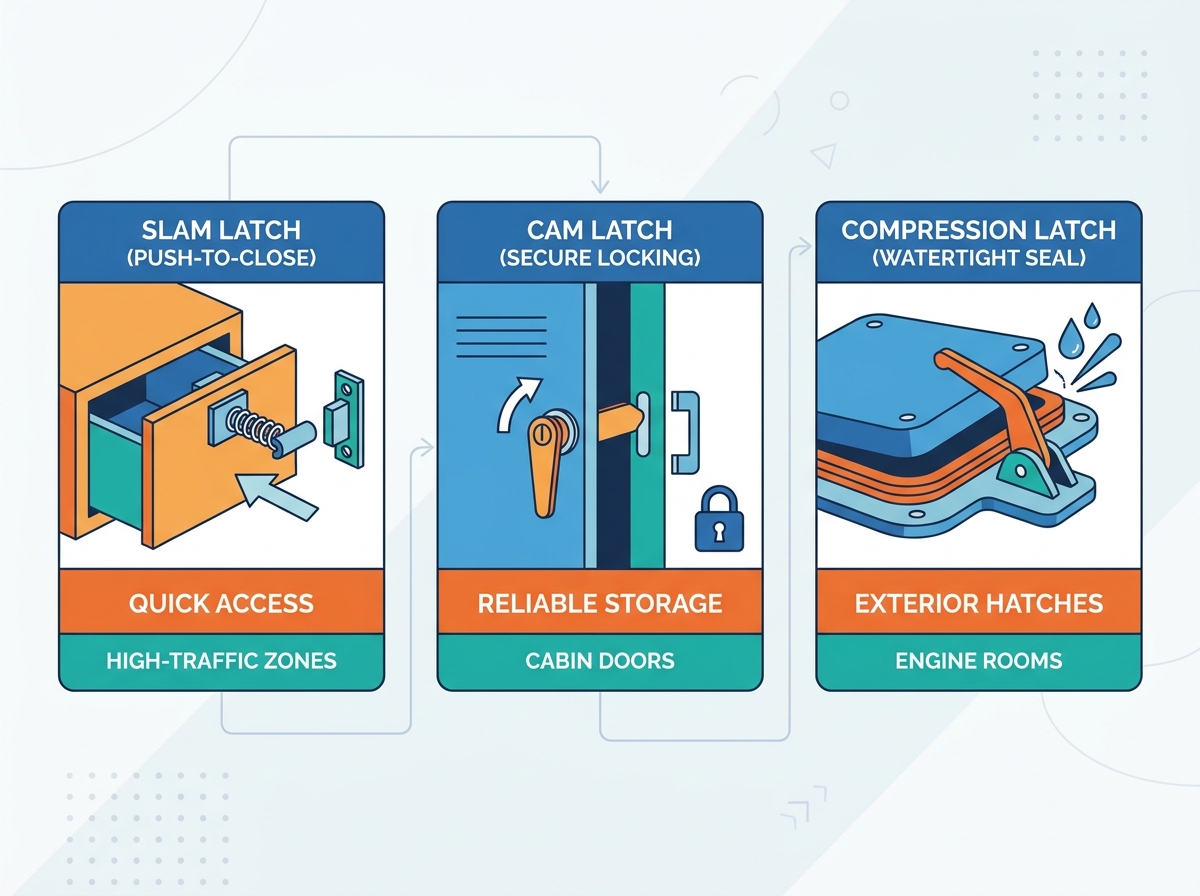
Match the mechanism to the motion: Slam latches offer quick access for high-traffic drawers, while compression latches provide necessary watertight seals for exterior deck hatches.
Material dictates lifespan: Prioritize 316-grade SS marine hardware over standard 304 stainless or unreinforced plastics to prevent pitting and mechanical failure in harsh environments.
Precision dictates performance: 90% of latch failures (especially in mobile environments) stem from improper grip range calculations and misaligned striker installations, not hardware defects.
Consolidate sourcing: Purchasing from established marine hardware manufacturers ensures dimensional consistency across the vessel, from cabin locks to exterior fittings.
1. Evaluating Marine Latch Constraints and Success Criteria
You must understand the environment before selecting any marine latch. The constraints on a vessel differ wildly from residential or commercial applications. Recognizing these unique stress points is the first step toward building a reliable system.
Environmental Exposure (Interior vs. Exterior)
Above-deck components face brutal conditions. They endure constant ultraviolet (UV) radiation, saltwater spray, and extreme temperature fluctuations. Exterior latches require high UV resistance and IP-rated watertight seals. Sunlight quickly degrades standard plastics, making them brittle. Saltwater initiates rapid oxidation on inferior metals.
Below-deck components face different challenges. They operate in high humidity environments. While they escape direct UV light, they still require corrosion-resistant materials to prevent seizing. A latch inside an engine room also battles chemical exposure from oils and fumes. You must evaluate the exact location of the installation first.
Vibration and Dynamic Loads
Boats do not sit still. They pound against waves and vibrate constantly from engine operation. A standard residential latch relies on gravity and minimal friction. It will fail under continuous hull pounding.
You need positive-locking mechanisms. These designs actively hold the latch pawl in place. They resist the dynamic loads pushing against the door or hatch. If you build mobile applications like expedition vehicles, road vibration creates similar dynamic loads. You must choose latches engineered specifically to stay shut during violent movement.
Panel Thickness and Grip Range
Grip range is the most critical sizing metric for any latch. It determines whether the mechanism will engage properly. To calculate it accurately, you cannot just measure the door.
You must measure the total compressed thickness. This includes the hatch panel, the frame, and the weather gasket. When you close the latch, the gasket compresses. Your calculated grip range must account for this compression. If you calculate it incorrectly, the latch will either rattle loosely or refuse to close entirely.
2. Core Marine Latch Types and Specific Use Cases
Different access points demand different mechanical actions. You cannot use a single latch style for every door on a vessel. Understanding the core mechanisms helps you match the hardware to the user's operational needs.
Slam Latches (Push-to-Close)
Slam latches feature a spring-loaded operation. They secure automatically the moment you push the door closed. You do not need to turn a handle to lock them. This makes them exceptionally convenient.
They are best used for high-traffic cabinetry, interior drawers, and baitwell lids. Users appreciate the quick access they provide. However, you must implement them carefully. Slam latches are prone to popping open under heavy vibration. If the striker alignment is even marginally off, the spring tension cannot hold the door. Always verify the striker plate position twice.
Cam Latches
Cam latches use a simple rotating lever. As you turn the handle, the internal cam catches behind the door frame. They offer direct, mechanical engagement without relying on springs.
They are highly versatile for standard storage lockers. They also serve as a highly reliable boat cabin sliding door lock. Despite their reliability, cam latches have limitations. They offer limited gasket compression compared to dedicated compression designs. They work best where absolute watertight integrity is not the primary goal.
Compression Latches
Compression latches actively pull the door inward. As you engage the mechanism, it tightens against the frame gasket. This creates a highly secure, watertight seal.
You should use these for engine room hatches, exterior lazarettes, and watertight bulkheads. They prevent water intrusion during heavy seas. To implement them correctly, you must calculate the gasket's compressed depth. If you adjust the latch too tightly, you will crush and ruin the gasket. If it is too loose, water will bypass the seal.
Specialty Latches & Fasteners
Certain applications require highly specialized designs. Niche hardware solves specific spatial or aesthetic problems. For example, you might need a low-profile marine window latch to secure heavy glass panels without obstructing the view. Other areas might benefit from anti-rattle flush pulls. These lie completely flat against the deck to prevent tripping hazards. They incorporate rubber bumpers to silence metal-on-metal noise.
Marine Latch Application Comparison
Latch Type
Primary Mechanism
Best Application
Vibration Resistance
Watertight Seal
Slam Latch
Spring-loaded pawl
Drawers, baitwells, interior cabinets
Moderate (Requires perfect alignment)
Poor
Cam Latch
Rotating lever/cam
Storage lockers, cabin sliding doors
High
Moderate
Compression Latch
Pull-and-tighten cam
Engine hatches, exterior lazarettes
Very High
Excellent
3. Material Specifications: The Case for SS Marine Hardware
Your hardware is only as good as the material it is forged from. In marine environments, the wrong alloy becomes a liability within weeks. You must understand the chemistry behind the components you install.
316 vs. 304 Stainless Steel
When selecting ss marine hardware, 316-grade stainless steel is the non-negotiable standard. You should never compromise on this for exterior applications. The secret lies in its composition. 316 stainless contains molybdenum.
This specific element dramatically increases resistance to chloride pitting. Saltwater is heavily laden with chlorides. Standard 304 stainless steel lacks molybdenum and will rust quickly when exposed to ocean spray. While 304 is cheaper and acceptable for residential kitchens, it fails rapidly on a boat deck. Always verify the steel grade before purchasing.
Marine-Grade Plastics and Composites
Metal is not always mandatory. Lightweight, non-corrosive plastics play a vital role in modern boat building. Materials like glass-filled nylon offer excellent strength-to-weight ratios. They never rust and require zero lubrication.
You should evaluate plastics for interior cabinetry, small glove boxes, and electronic covers. They reduce overall vessel weight significantly. However, you must avoid unreinforced plastics. They flex under load and degrade quickly. Keep plastic components away from high-stress structural points or heavy engine hatches.
Galvanic Corrosion Risks
You must actively prevent galvanic corrosion during installation. This occurs when you mix dissimilar metals in a saltwater environment. Saltwater acts as an electrolyte. It facilitates an electrical current between the differing metals, causing the less noble metal to disintegrate.
A common mistake is installing a heavy stainless latch using cheap aluminum rivets. The aluminum will sacrifice itself to the stainless steel. Within a season, the rivets will turn to white powder, and the latch will fall out. Always use matching 316 stainless fasteners. If you must mount stainless hardware onto an aluminum hull, use proper dielectric isolation pads. You must break the electrical connection between the metals.
4. Pre-Installation Planning and Hardware Ecosystem
Successful installations begin long before you pick up a drill. Proper planning saves time, prevents costly structural mistakes, and ensures a cohesive final appearance.
Retrofitting vs. New Builds
Replacing legacy latches introduces complex challenges. In a new build, you dictate the cutout sizes. When retrofitting, you are constrained by existing holes in the fiberglass or wood.
You must prioritize matching the existing cutout dimensions. If a new latch requires a slightly larger hole, you can carefully trim the panel. However, if the new latch is smaller than the old hole, you face a major problem. You will have to patch the fiberglass. Fiberglass patching is time-consuming, expensive, and difficult to color-match perfectly. Always measure the original cutout twice.
Aesthetic and Functional Consistency
A vessel looks best when its hardware shares a unified design language. Mixing brushed steel finishes with polished chrome looks chaotic. Mixing square profiles with rounded bezels feels disjointed.
You create visual harmony by matching finishes and profiles across the entire vessel. The best way to achieve this is to consolidate your sourcing. Purchasing consistently from reputable marine hardware manufacturers ensures a unified look. It also guarantees dimensional consistency. You will know exactly how the parts operate and how they withstand the environment.
Broader Hardware Integration
Latch upgrades rarely happen in isolation. They often coincide with broader deck and cabin improvements. As you plan your latch replacements, look at the surrounding components.
You should plan for complementary refits. Upgrading a worn cabinet latch might inspire you to install a modern boat cleat door handle nearby. If you are re-fitting the exterior deck, you might simultaneously replace your heavily corroded boarding ladder hardware. Even structural safety items deserve attention during a major refit. You could upgrade an old anchor joining shackle to match the new 316 stainless standard of your deck hardware. Comprehensive planning elevates the entire vessel.
5. Execution: Marine Latch Installation Realities
The best latch in the world fails if installed poorly. Execution requires patience, the right chemical sealants, and exact mechanical alignment. Follow these steps meticulously.
Step 1: Templating and Cutout Preparation
Never freehand a cutout. You must use the manufacturer-supplied templates for every single hole.
Tape the paper template securely to the panel surface.
Use a center punch to mark the exact drilling points.
Mask the surrounding area with heavy painter's tape. This prevents the gelcoat from chipping or spider-cracking when the drill bit catches.
Use sharp, high-quality hole saws or jigsaws designed for fiberglass. Run them at appropriate speeds to avoid burning the resin.
Step 2: Bedding and Sealing
Water intrusion destroys panel cores. You must seal the hardware properly to protect the structural integrity of the door.
Clean the mounting surface with denatured alcohol to remove wax and grease.
Apply a continuous bead of marine-grade sealant under the latch flange. Polyurethane or polysulfide sealants work best. They provide excellent adhesion and flexibility.
Seat the latch firmly, allowing a small amount of sealant to squeeze out around the edges.
Warning: Avoid silicone sealants. Silicone leaves a stubborn residue that permanently contaminates the fiberglass. It makes future paint or gelcoat repairs nearly impossible.
Step 3: Striker Alignment and Gasket Calibration
Mechanical alignment separates amateur work from professional results. The pawl or cam must engage the striker plate flawlessly.
Install the latch body first, leaving the striker plate slightly loose.
Close the door gently to mark the natural resting point of the mechanism.
Adjust the striker plate to meet the pawl exactly. Tighten the striker plate fully.
For compression latches, adjust the set-screws on the cam arm. You want to achieve a firm, watertight seal without over-crushing the rubber gasket. If the gasket flattens completely, it loses its elastic memory.
Step 4: Torque and Fastener Selection
Engine vibration acts like a wrench, slowly backing out loose nuts. You must secure the hardware permanently.
Avoid standard hex nuts and lock washers. They will inevitably vibrate loose over time.
Specify the use of nylon-insert lock nuts (Nylocs) for all through-bolts. The nylon insert grips the bolt threads tightly, resisting vibration.
If you must use blind tapped holes, apply a medium-strength thread-locking fluid to the screws before insertion.
Tighten all backing plates evenly in a cross-pattern to prevent distorting the latch frame.
6. Shortlisting Logic and Next Steps
Selecting hardware does not have to be overwhelming. You can streamline your decision-making process by following a simple, logical sequence. Ask yourself a few critical questions before buying.
Define the Application: What is the primary job of this panel? If it must be watertight, you need a compression latch. If it sees high traffic and needs quick access, you need a slam latch. If it is purely for security, a deadbolt or cam latch works best.
Measure Twice: Confirm the exact grip range. Always add the door thickness and the compressed gasket thickness together. Never guess this number.
Select the Grade: Choose your materials strictly based on location. Demand 316 stainless steel for exteriors. Accept high-grade composites for protected interiors to save weight.
Call to Action: Do not rely on marketing photos alone. Promptly consult the technical specification sheets provided by the manufacturer. If you remain unsure about load ratings or cutout dimensions, contact a hardware specialist to finalize your parts list. They can verify your selections against industry standards.
Conclusion
Successful hardware implementation is a delicate mix of uncompromising material selection and precise dimensional alignment. You must respect the harsh reality of the marine environment. Choosing true 316 stainless steel prevents catastrophic failures at sea.
Furthermore, taking the time to calculate grip ranges and align strikers perfectly ensures smooth operation for years. Buyers must remember that prioritizing solid engineering over flashy aesthetics prevents continuous maintenance loops. Quality latches ensure long-term vessel security, protect your interior from water damage, and provide peace of mind every time you leave the dock.
FAQ
Q: What is the difference between a marine-grade latch and an RV latch?
A: Marine-grade latches utilize 316 stainless steel to survive aggressive saltwater corrosion. They feature higher UV stabilization for plastics and superior vibration resistance to handle hull pounding. While many cross-over builders use marine hardware in RVs to benefit from this extreme durability, standard RV latches will quickly rust and fail if used on a boat.
Q: How do I measure the "grip range" for a replacement latch?
A: You calculate grip range using a concise formula: Panel thickness + Frame thickness + Gasket thickness when compressed. You must measure the gasket while it is squeezed tight, not in its relaxed state. This total measurement ensures the latch cam securely engages the frame without rattling or crushing the seal.
Q: Why is my slam latch continually popping open in rough water?
A: This happens due to common implementation failures. The spring tension might be inadequate for the heavy weight of the door. More commonly, you have a misaligned striker plate. If the alignment prevents the internal pawl from extending fully into the catch, normal vessel vibration will easily jolt the door open.
Q: Can I use standard stainless steel hardware on my boat?
A: No. You must avoid standard commercial 304-grade stainless steel on the exterior of your boat. It lacks molybdenum, making it highly susceptible to chloride pitting from saltwater exposure. You must reinforce the necessity of 316 marine-grade hardware to avoid rapid rust, aesthetic degradation, and structural failure.