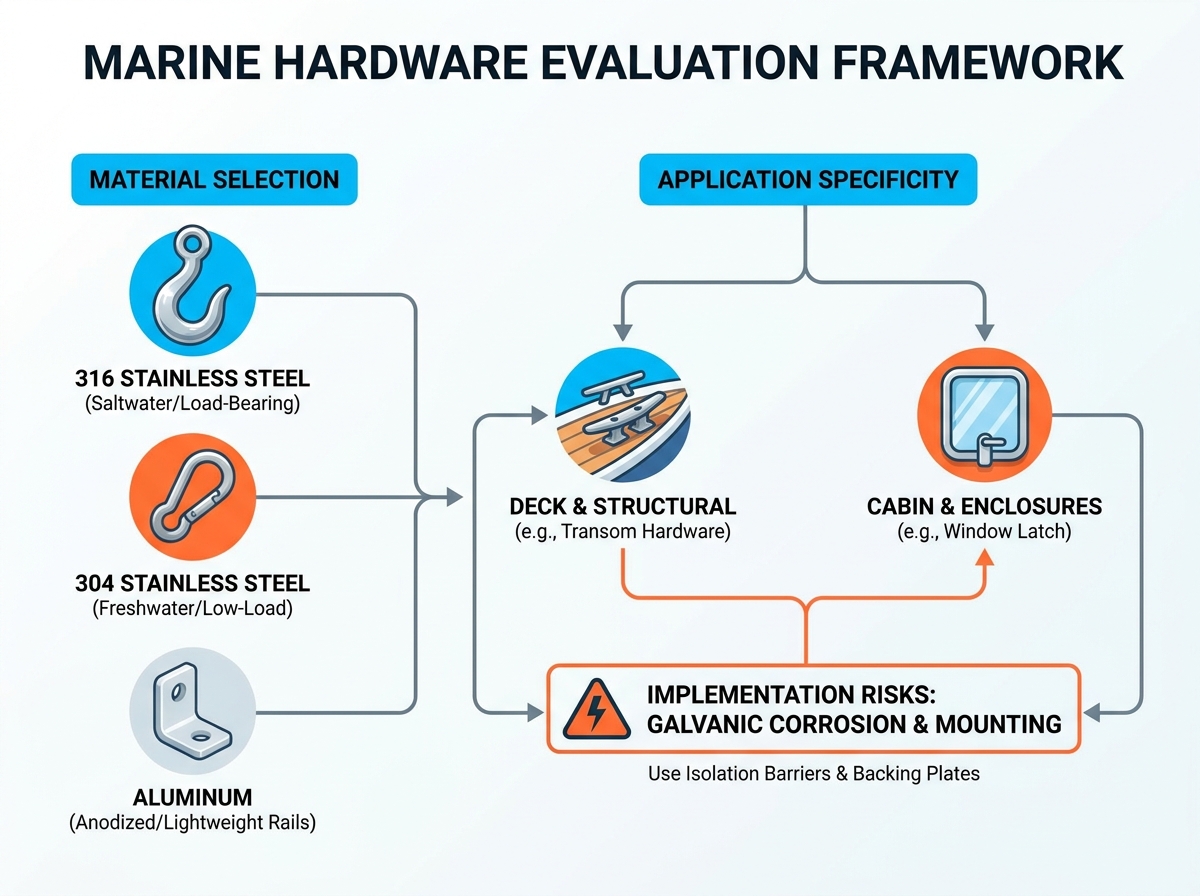
Out on the water, your safety relies heavily on the small components securing your vessel. Substandard marine clips, hooks, and latches do not just cause operational frustration. They introduce critical failure points during docking, heavy weather, or high-speed transit. When equipment fails under load, the resulting damage can be catastrophic.
Selecting the right components requires balancing environmental resistance against saltwater or freshwater conditions. You must evaluate working load limits (WLL) alongside mounting integrity. Even the strongest steel will rip through fiberglass if poorly installed. Preventing sudden pull-outs demands careful attention to detail.
This guide provides an objective, engineering-focused framework. We will help you evaluate, shortlist, and correctly install hooks, clips, and specialized brackets. Follow these principles to ensure long-term reliability. A methodical approach secures your peace of mind on every single voyage.
Key Takeaways
Material Dictates Lifespan: 316-grade stainless steel remains the gold standard for saltwater, while aluminum and advanced composites offer weight savings for specific freshwater applications.
Application Specificity Matters: General-purpose clips cannot replace specialized components like a boat sliding window latch or heavy-duty boat transom hardware.
Installation is the Weakest Link: Even premium hardware will fail if mounted without proper backing plates, sealants, or galvanic corrosion prevention.
Sourcing Safely: Prioritize marine-specific suppliers with transparent load-rating data over generic local retailers.
Evaluating Core Marine Hardware Categories by Application
Deck, Docking, & Structural Components
Heavy loads characterize deck and docking applications. Dynamic forces multiply rapidly when waves strike a moored vessel. To survive these stresses, you must focus on sheer strength. We highly recommend utilizing heavy-duty boat transom hardware designed explicitly for immense tension. Always evaluate backing plate compatibility. Proper backing plates distribute pulling loads across a much wider area of fiberglass. Without them, sudden shock loads will easily fracture your hull.
Next, examine structural mounting systems. Modern vessels frequently utilize boat t rail brackets to secure heavy accessories. You must assess their modularity and locking mechanisms carefully. High-speed transit generates intense vibration. Robust brackets lock securely and prevent gear from shifting. We advise testing the clamping force of these brackets before committing to a permanent installation.
Cabin, Enclosures, & Upholstery
Moving inward to the cabin requires a shift in engineering focus. Precision tolerances dictate success here. A quality boat windscreen latch must withstand relentless slamming and continuous vibration. Evaluate these latches for watertight compression. If the manufacturer uses polymers, demand UV-stabilized materials to prevent brittleness over time.
Similarly, evaluating a boat sliding window latch requires attention to detail. Loose mechanisms rattle endlessly underway. They also permit rainwater intrusion during heavy squalls. Internal gaskets must provide a tight seal. When outfitting the interior, look closely at boat cushion hardware. You need snag-free designs. Hidden snap fasteners and low-profile tracks perform excellently. They endure continuous tension and resist moisture perfectly without staining expensive upholstery fabrics.
Aesthetic vs. Functional Choices
Sometimes, visual appeal drives purchasing decisions. Restoring a vintage vessel often demands specific visual profiles. We see many owners drawn to classic boat hardware for its timeless charm. However, you must weigh the aesthetic necessity of bronze or chrome-plated brass against harsh maintenance realities.
Bronze inevitably develops a green patina. Chrome plating will pit rapidly if neglected. You will spend countless hours polishing these metals to keep them corrosion-free. Modern stainless alternatives offer vastly superior performance. Yet, traditionalists often prefer authentic period-correct metals. Make this choice carefully based on your willingness to perform regular upkeep.
Material Selection: Balancing Cost, Strength, and Environment
316 vs. 304 Stainless Steel
Understanding metallurgy prevents costly mistakes. Manufacturers use 304 stainless steel extensively because it contains chromium and nickel. It resists mild corrosion well. However, 304 pits rapidly in harsh marine environments. Chloride ions in saltwater attack its protective passive layer mercilessly.
Conversely, 316 stainless steel contains a crucial addition: molybdenum. This specific element drastically improves chloride resistance. For critical load-bearing hooks and clips, 316 remains entirely non-negotiable. You cannot compromise on structural marine hardware. Specifying the correct metal grade directly impacts vessel safety and longevity.
Marine-Grade Aluminum (Anodized)
Anodized aluminum offers incredible weight savings. We utilize it frequently for lightweight structural rails and bimini frames. It performs admirably in freshwater applications. The anodized coating protects the raw metal beneath.
However, serious limitations exist. Aluminum acts as an anode when paired directly against stainless steel. Saltwater functions as an electrolyte. This combination creates a severe galvanic corrosion risk. The aluminum will literally dissolve over time. Never mix these metals without strict isolation protocols.
High-Density Composites & Nylons
Advanced composites ignore galvanic corrosion entirely. They never rust or pit. We evaluate them highly for non-load-bearing applications. Specific clip retainers, hatch dogs, and minor latches often utilize high-density nylons.
Despite their corrosion immunity, UV degradation remains a significant risk. Relentless sunlight breaks down standard plastics quickly. They become brittle and shatter. You must demand UV-stabilized polymers. Zero-corrosion benefits only matter if the component survives daily sun exposure.
The chart below outlines the key properties of primary marine materials to simplify your evaluation process.
Material
Primary Use Case
Corrosion Resistance
Key Limitation
316 Stainless Steel
Heavy load-bearing clips, structural mounts
Excellent (Saltwater)
High initial purchase cost
304 Stainless Steel
Interior cabin fittings, freshwater use
Moderate (Freshwater)
Prone to chloride pitting in saltwater
Anodized Aluminum
Lightweight rails, framing brackets
Good (Freshwater/Light Salt)
Severe galvanic corrosion risk
High-Density Composite
Non-load-bearing retainers, minor latches
Absolute (Immune to rust)
Vulnerable to UV degradation
Implementation Risks: Mounting and Galvanic Corrosion
The Galvanic Scale Threat
Mixing dissimilar metals guarantees component failure. Engineers refer to this as the galvanic scale threat. Driving stainless steel fasteners through an aluminum bracket effectively creates a battery. The less noble metal sacrifices itself rapidly.
You must mandate strict isolation barriers to prevent this chemical reaction. We apply Tef-Gel generously on all mismatched threads. We also insert nylon washers between the bracket and the fastener head. These small preventative steps stop catastrophic structural failures before they begin.
Load Distribution Assumptions
High-tension hooks endure massive stress daily. Cleats, lifting rings, and heavy latches handle extreme shock loads. Mounting these items directly to bare fiberglass causes immediate structural failure. The fiberglass will flex, crack, and eventually tear out entirely.
We highlight the absolute necessity of proper load distribution. Heavy-duty applications demand thick aluminum or G10 fiberglass backing plates. They distribute immense forces across a much larger surface area. Large load-spreading washers provide a minimum viable alternative for lighter loads, but full backing plates remain superior.
Sealing & Bedding
Water intrusion destroys boat cores silently. Balsa and plywood rot rapidly once moisture enters the laminate. You must carefully assess your marine sealant requirements during installation. Proper bedding stops insidious leaks.
Follow these specific sealing best practices for optimal results:
Clean the mounting surface thoroughly using denatured alcohol to remove all waxes and oils.
Select the correct sealant type based on the need for permanence versus future removal.
Apply marine-grade polyurethane for permanent structural bonds requiring extreme adhesion.
Utilize polysulfide for components needing future removal. It resists chemicals but remains flexible.
Avoid household silicone entirely below the waterline, as it lacks necessary structural adhesion.
Sourcing Strategy: Choosing the Right Supplier
Evaluating Specifications
Never purchase unrated maritime equipment. You must demand transparent Working Load Limits (WLL). We also require clear Breaking Strength data. Avoid any components marketed simply as "stainless" without a specific numerical grade attached.
If a supplier refuses to specify the exact metallurgy, walk away immediately. Legitimate manufacturers test their products rigorously under stress. They publish these figures openly. You rely on this data to calculate safety margins accurately.
Online Specialists vs. Local Retailers
Convenience frequently ruins quality. You might instinctively search for a boat hardware store near me. Exercise extreme caution. Generic sporting goods stores often sell unrated pot-metal clips. They look shiny on the shelf but snap under minimal strain.
Prioritize vendors specializing strictly in marine supply. Dedicated suppliers understand harsh aquatic environments. They provide detailed specification sheets. Their tested products ensure your vessel remains safe during intense storms.
Warranty & Return Policies
The marine environment destroys weak components aggressively. Factor the supplier’s warranty into your purchasing decision. Scrutinize their replacement policy carefully. Hardware exhibiting premature rust indicates poor metallurgy or contaminated forging processes.
Mechanical failure within the first season reveals severe manufacturing defects. Top-tier suppliers stand behind their gear confidently. They replace defective parts immediately without hassle. A strong warranty proves the manufacturer trusts their own engineering.
Conclusion
Securing your vessel requires a methodical, engineering-based approach. You cannot compromise on structural integrity. Inferior metals and lazy installation practices always result in failure.
To ensure maximum reliability, implement these action-oriented next steps:
Audit your current vessel today and identify any pitted, bent, or loose components.
Categorize your replacement needs strictly based on working load versus simple utility.
Specify 316 stainless steel for all exterior load-bearing applications.
Consult a dedicated marine supplier for precise component matching and verified load data.
FAQ
Q: What is the difference between marine-grade stainless steel and standard stainless?
A: The primary difference lies in the chemical composition. Marine-grade 316 stainless steel contains molybdenum. This specific addition drastically improves resistance to chloride, preventing the deep pitting and rust you typically see when standard 304 stainless steel faces constant saltwater exposure.
Q: Can I use standard zinc-plated hardware on a freshwater boat?
A: We strongly advise against it. Zinc plating offers a very short lifespan in environments with constant moisture. Even in freshwater, the thin plating wears off quickly, leading to rapid rust. We recommend using anodized aluminum or 316 stainless steel to ensure longevity.
Q: How do I prevent classic boat hardware from tarnishing?
A: Bronze and chrome-plated brass require extensive, ongoing maintenance. To prevent tarnishing, you must polish the metals regularly using specialized marine compounds. After polishing, apply high-quality protective marine sealants or synthetic waxes to create a barrier against moisture and oxidation.
Q: What is the best way to secure a boat sliding window latch that keeps rattling?
A: First, evaluate the internal rubber gasket and compression mechanism. These components often dry out and shrink. Next, check the mounting screws. If they spin freely, they have stripped the fiberglass. You will need to fill the holes with marine epoxy and redrill them for a tight fit.