Component failure in marine environments carries a disproportionately high cost compared to initial part prices. A single compromised fastener can trigger catastrophic rigging failure offshore. Similarly, an underspecified shackle might cause severe water ingress. This exposes builders to major compliance liabilities. Boatbuilders, refitters, and procurement managers need highly reliable systems. We designed this guide as a robust technical evaluation framework. You will learn how to accurately assess structural integrity. We also explore ways to select highly functional parts safely. Our baseline criteria assume your vessels operate in extreme conditions. We focus specifically on high-salinity and high-UV saltwater environments. In these harsh zones, cyclic wind loads act as primary threats. Galvanic corrosion aggressively attacks inferior metals here too. Understanding these dynamic forces helps you procure significantly better materials.
Key Takeaways
Material selection must balance tensile strength with corrosion resistance (e.g., navigating the trade-offs of 316 stainless steel vs. silicon bronze).
Rigging components require verifiable Working Load Limits (WLL) and material certifications—never rely solely on theoretical breaking strengths.
Cabin and deck hardware (from latches to boarding components) must be evaluated on both ergonomic function and watertight integrity.
Selecting reliable manufacturers requires auditing their quality assurance processes, raw material sourcing, and compliance with maritime standards (ABYC, ISO).
Evaluating Structural Integrity: The Physics of Marine Fasteners
Marine environments brutally test every single metal component aboard. You must define specific operational threats before selecting any parts. Crevice corrosion destroys metals hidden away from oxygen sources. Galvanic corrosion occurs rapidly when dissimilar metals interact in saltwater. Metal fatigue builds up silently under continuous cyclic wind loads. Wave impacts amplify these physical stresses exponentially over time.
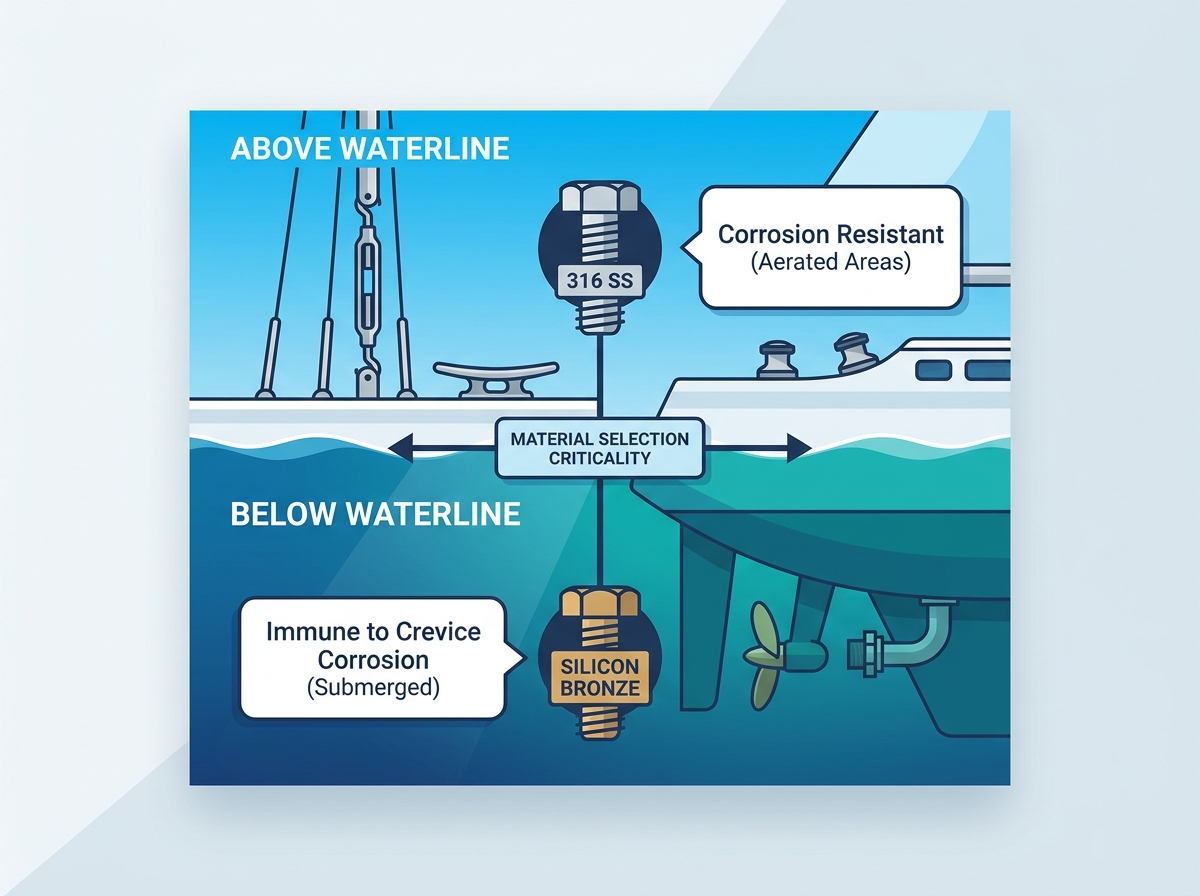
To combat these threats effectively, you need a strict material matrix. We utilize ss marine hardware as the industry baseline for above-waterline applications. Grades 316 and 316L stainless steel perform exceptionally well here. They contain added molybdenum. This chemical addition successfully resists chloride pitting. However, stainless steel relies entirely on free oxygen. It needs oxygen to maintain its protective chromium oxide layer. It becomes highly susceptible to crevice corrosion in oxygen-deprived zones. You should never use it for threaded through-hulls below the waterline.
Silicon bronze offers vastly superior performance for below-waterline fastening tasks. Boatbuilders favor it heavily in traditional wooden boat construction. It remains virtually immune to hidden crevice corrosion. It also provides excellent tensile strength for critical structural joints.
Titanium and high-alloy metals serve weight-critical racing applications. Racing syndicates use them to shed heavy rigging weight aloft. They balance extreme material costs against absolute performance requirements.
Material Type
Primary Application Area
Corrosion Resistance Level
Key Vulnerability
316/316L Stainless Steel
Above-waterline deck hardware
High (in oxygen-rich zones)
Crevice corrosion when deprived of oxygen
Silicon Bronze
Below-waterline fastening
Very High (saltwater environments)
Lower shear strength compared to steel
Titanium Alloys
High-performance racing rigging
Exceptional (immune to chlorides)
High cost and galvanic incompatibility
Critical Rigging Hardware & Load Management
Rigging networks are only ever as strong as their weakest pin. You must evaluate load specifications with absolute precision. Manufacturers use Minimum Breaking Load (MBL) to indicate absolute failure points. You should never design active systems around MBL ratings. Instead, prioritize Working Load Limit (WLL) and Safe Working Load (SWL). WLL represents the maximum safe continuous force for tensioning. SWL factors in dynamic environmental loads like sudden wave shocks.
Primary rigging nodes always demand careful sizing and evaluation. Take the anchor joining shackle, for example. You must size its parameters perfectly. This vital piece connects the heavy chain directly to the anchor shank. Always specify forged construction over cheaper cast alternatives. Forged steel physically aligns the internal grain structure during manufacturing. This yields vastly superior tensile strength under load. You also need safety wire or mousing on captive pins. This simple step prevents vibration back-out during heavy seas.
Follow these critical steps when inspecting turnbuckles and swage fittings:
Evaluate thread types carefully for precise machining tolerances.
Ensure toggle articulation moves freely in all directions.
Confirm toggle movement prevents metal fatigue at the swage terminal.
Inspect internal threads visually for early signs of galling.
Verify all terminal ends lack microscopic stress fractures.
Commercial and insured vessels demand strict maritime compliance. Always require stamped, traceable load ratings on every rigging component. Classification societies like ABYC mandate this level of documentation for insured vessels.
Deck, Cabin, and Functional Hardware Selection
Transitioning from structural rigging to user-facing hardware shifts your design focus. You must prioritize weather-tightness alongside security in heavy seas. External deck components endure massive physical stress daily. Your boarding ladder hardware requires intensive, real-world stress-testing. Transom and gunwale mounts face extreme shear loads. This happens every time passengers board the vessel. Always install substantial backing plates behind fiberglass structures. These plates distribute localized forces safely across the hull.
Ergonomics matter just as much as ultimate structural strength. Consider installing a dual-purpose boat cleat door handle. It provides an ergonomic, secure grip in wet conditions. Yet, its smooth profile must never create snag hazards. Snagged running rigging creates immediate danger for the crew.
Cabin interiors and enclosures actively protect the crew below decks. A highly reliable marine window latch ensures vital structural safety. Assess its internal compression seals and heavy dogging mechanisms carefully. High vibration resistance helps maintain positive cabin pressure continuously. This mechanism directly prevents dangerous water ingress during offshore storms.
Security enclosures demand robust engineering and premium materials. Your boat cabin sliding door lock faces unique physical challenges. Normal hull flex can easily jam inferior locking mechanisms.
Look for these essential features in cabin security hardware:
Heavy-duty track mechanisms resistant to salt crystal buildup.
Corrosion-resistant internal tumblers machined from solid brass or bronze.
Positive lock engagement functional even when the hull distorts.
Ergonomic interior release handles for emergency egress.
Vetting Marine Hardware Manufacturers & Suppliers
Finding dependable supply partners takes considerable time and effort. You must separate primary manufacturers from simple white-label distributors. Primary producers strictly control the underlying metallurgical process. Distributors usually just rebox finished goods from unknown foundries.
Traceability serves as your most important evaluation dimension. Always request Mill Test Reports (MTRs) before purchasing bulk batches. MTRs verify the actual metal composition scientifically. They ensure your batch actually meets the necessary chemical threshold. Without an MTR, you gamble directly on structural integrity.
Next, assess their physical manufacturing processes thoroughly. Forged components are absolutely mandatory for load-bearing applications. The forging process aligns the metal's grain structure perfectly. This delivers much higher tensile strength and fatigue resistance. Casting works fine for low-load aesthetic pieces only. Cast parts often fail unpredictably under sudden shock loads.
Finally, evaluate the top marine hardware manufacturers comprehensively. Analyze their historical return rates carefully. Demand total warranty transparency before signing procurement contracts. Look for strict corporate adherence to ISO 9001 standards. High-tier suppliers also hold marine-specific product classifications. Certifications from Lloyd's Register or ABS prove consistent manufacturing quality. Quality assurance processes dictate the long-term reliability of your builds.
Implementation Risks & Maintenance Realities
Even perfect parts fail rapidly if installed poorly. Galvanic corrosion mitigation is absolutely non-negotiable aboard any vessel. You must isolate dissimilar metals whenever they touch. Aluminum masts interacting with stainless rivets create classic galvanic batteries. Best practices include using specialized dielectric pastes during assembly. Nylon washers also break the electrical circuit highly effectively. Applying Tef-Gel prevents raw aluminum from reacting against stainless steel screws.
Thread galling frequently ruins expensive fasteners during initial installation. Stainless-on-stainless threads often seize up under high rotational pressure. Friction breaks down the protective microscopic oxide layer instantly. The bare metals then cold-weld together permanently. You can prevent this frustrating issue quite easily. Specify proper lubrication protocols during the early build phase. Apply marine-grade anti-seize compounds to every single threaded fitting.
Ongoing maintenance requires establishing strict lifecycle auditing practices. Establish a realistic, documented inspection schedule for your maintenance crew. Conduct visual checks for brown rust weeping around deck fittings. Schedule regular dye penetrant testing for critical rigging terminals. This non-destructive test reveals microscopic cracks safely. It identifies metal fatigue long before catastrophic failure ever occurs.
Conclusion
High-grade structural components keep vessels entirely safe in unforgiving environments. Certified fittings dramatically reduce your lifetime maintenance requirements. They also minimize severe compliance and liability risks effectively. Taking shortcuts on metal quality always introduces unnecessary, dangerous vulnerabilities.
Audit your current Bill of Materials immediately. Request verifiable material samples from your highly shortlisted vendors. If you manage complex high-load applications, consult an accredited marine surveyor. They can help specify exact engineering tolerances. They ensure your unique vessel remains completely structurally sound.
FAQ
Q: Can I use 304 stainless steel instead of 316 for marine applications?
A: You should avoid using 304 stainless steel for exterior marine applications. Grade 304 lacks molybdenum, making it highly susceptible to rapid surface oxidation and chloride pitting in saltwater. You can safely restrict 304 stainless steel strictly to dry cabin interiors. Always specify 316 or 316L for above-waterline exterior components.
Q: How do I choose the correct size anchor joining shackle?
A: You must match the shackle pin diameter to both the chain link size and the anchor shank. A loose fit causes excessive wear, while a tight fit prevents proper articulation. Always prioritize high-tensile forged steel over cast variants. Additionally, select an oversized WLL to handle dynamic shock loads when anchoring.
Q: What causes stainless steel marine hardware to rust?
A: Stainless steel relies on ambient oxygen to maintain a passive, corrosion-resistant oxide layer. Oxygen starvation in wet, sealed environments causes crevice corrosion. Chloride accumulation from dried saltwater also attacks the surface. Furthermore, contamination from non-stainless tooling during installation embeds rust-prone iron particles directly into the hardware surface.
Q: Is it safe to mix titanium and stainless steel in rigging?
A: Mixing titanium and stainless steel introduces galvanic corrosion risks. Titanium acts as a highly noble metal on the galvanic scale. When connected to stainless steel in a saltwater electrolyte, it accelerates corrosion in the stainless component. You must ensure complete electrical isolation using dielectric pastes or specialized isolating washers.