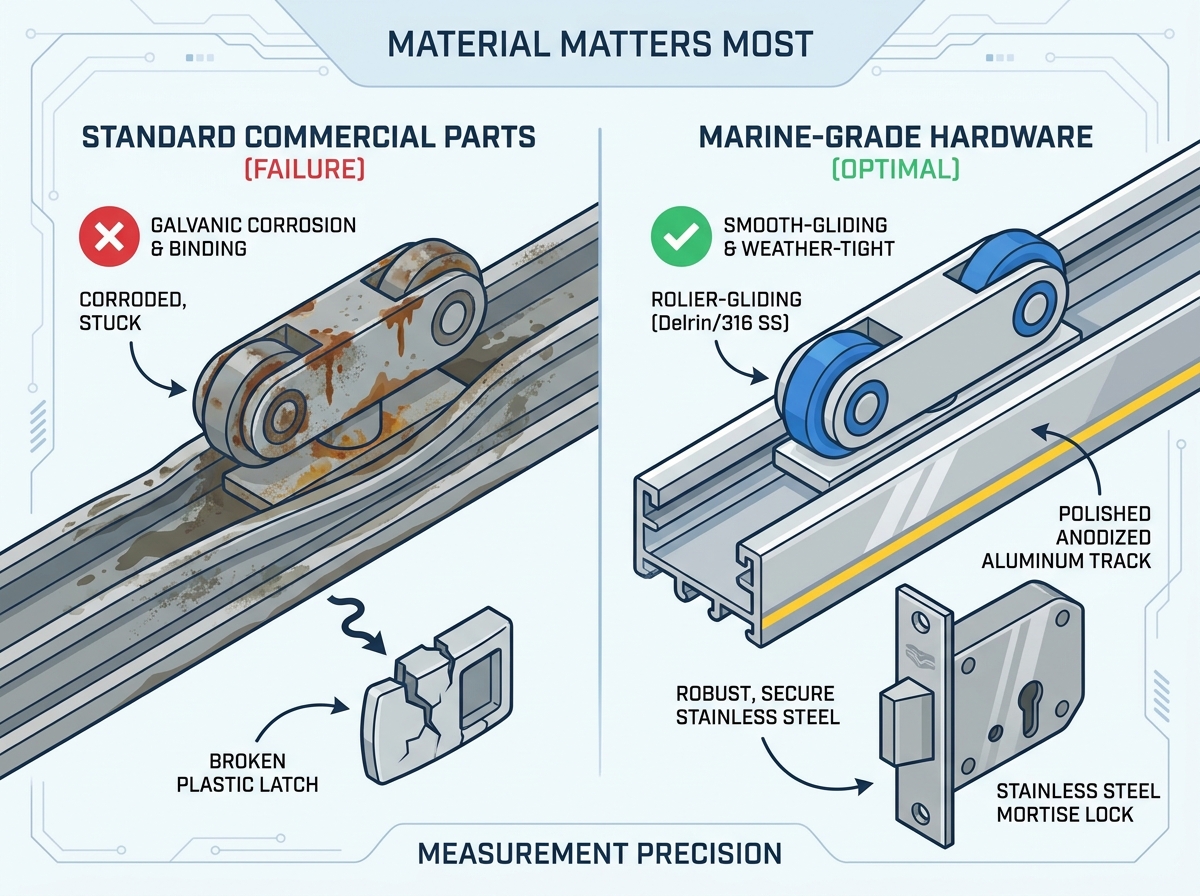
Sticking cabin doors, rattling windows, and failing latches quickly ruin your time on the water. Constant saltwater exposure, relentless vibration, and harsh UV degradation cause these compounding failures. Over time, friction increases, seals fail, and simple actions like opening a door require frustrating effort.
Replacing compromised systems using standard commercial parts almost always backfires. Non-marine components trigger accelerated galvanic corrosion, causing tracks to bind and rollers to shatter unexpectedly. Relying on inferior materials introduces serious safety hazards when heavy glass panels swing out of control in rough seas.
This guide provides a clear technical evaluation framework for sourcing, specifying, and installing proper marine hardware. You will learn how to accurately measure existing tracks, select appropriate roller alloys, and align heavy cabin doors. Applying these professional techniques guarantees long-term operational smooth-gliding and weather-tight security across your entire vessel.
Key Takeaways
Material matters most: 316 stainless steel, Delrin (acetal), and anodized aluminum are the only acceptable materials for high-friction sliding environments.
Measurement precision is non-negotiable: Track width, roller diameter, and glass thickness must be measured with digital calipers prior to ordering.
System alignment dictates lifespan: Even premium hardware will fail prematurely if hull flex and cabin door track alignment are not accounted for during installation.
Holistic sourcing prevents mismatches: Consolidating purchases for latches, tracks, and surrounding fixtures ensures visual and functional consistency across the vessel.
Identifying Root Causes of Sliding Hardware Failure
Understanding exactly why your current setup failed is a critical first step. Replacing a broken part without addressing the underlying environmental stress simply resets the countdown to the next failure. Marine environments punish sliding mechanisms through three primary degradation pathways.
First, galvanic corrosion destroys dissimilar metals aggressively. When manufacturers pair aluminum tracks with cheap steel roller bearings, they inadvertently create a battery. Saltwater acts as the electrolyte, accelerating electron transfer between the metals. The less noble aluminum track rapidly pits, oxidizes, and disintegrates. This chemical reaction leaves behind a powdery white residue. It causes severe track binding and eventually seizes the roller carriage entirely.
Second, track deformity and hull flex ruin mechanical alignments. A boat hull is not a rigid structure. As a vessel punches through heavy seas, the fiberglass flexes naturally. This dynamic movement pinches aluminum or plastic sliding tracks. Over time, repetitive pinching forces squeeze the track channels inward. This physical deformation crushes roller bearings and leads to permanently stuck doors. Ignoring hull flex during installation guarantees premature hardware failure.
Third, UV and environmental degradation destroy non-metallic components. Constant sunlight breaks down inferior plastic components, standard weatherstripping, and nylon window guides. UV radiation strips the plasticizers from these materials. They become brittle, shrink, and eventually crack under minimal pressure. You will often notice this degradation when black rubber seals turn chalky and leave dark streaks on the deck.
This diagnosis creates an important decision pivot. Identifying exactly how the previous components failed dictates your new material requirements. If galvanic corrosion destroyed your aluminum tracks, you must upgrade to isolated Delrin rollers. If UV exposure shattered your plastic latches, you need UV-stabilized acetal or stainless steel replacements. Tailoring your upgrade to solve the specific failure mode ensures lasting reliability.
Core Evaluation Criteria for Marine Hardware Selection
Selecting replacement parts requires balancing load capacities against environmental resistance. You must evaluate each component based on structural demands and intended application.
Roller Carriages & Track Systems
Engineers face significant material tradeoffs when specifying roller carriages. Stainless steel wheels offer exceptional load capacities for heavy glass doors. However, stainless steel introduces a high risk of track wear. Hard steel rollers will gradually carve deep grooves into softer aluminum tracks over years of use.
Conversely, Delrin or Teflon wheels provide an incredibly smooth glide. They operate quietly and carry absolutely zero corrosion risk. Their primary drawback is a lower static load capacity. Heavy impacts can sometimes flat-spot plastic rollers if the door drops suddenly. You must choose the wheel material based on the exact weight of your sliding panel.
Track profiles also require careful evaluation. Top-hung systems suspend the door weight from a heavy upper track. This design keeps the sensitive roller mechanisms far away from deck-level saltwater pooling. Bottom-rolling systems place the load on the deck track. If you select a bottom-rolling configuration, you must assess track drainage requirements. Water must escape quickly through engineered weep holes to prevent bearing immersion.
Locking Mechanisms & Latches
Securing a vessel involves balancing robust security against fast accessibility. Flush-mount slam latches offer incredible convenience. They engage automatically when you slide the door shut. However, they generally provide lower forced-entry resistance. Heavy-duty mortise locks require manual key engagement but offer superior offshore security. They resist violent impacts from waves smashing against the cabin.
Targeted applications demand purpose-built locking solutions. Sourcing a specialized boat sliding window latch prevents windows from creeping open under intense engine vibration. Similarly, installing a robust boat windscreen latch keeps heavy glass securely pinned open. These specific latches are engineered to withstand sudden, violent wind loads without shattering the surrounding tempered glass.
Aesthetic Alignment
Hardware upgrades should respect the original design language of your vessel. Matching vessel eras prevents visual clashes. If you are restoring an older vessel, you should specify polished stainless steel or brass classic boat hardware. These traditional finishes maintain authentic styling.
Modern vessels require a different approach. Contemporary center consoles and luxury cruisers often utilize matte black or clear anodized finishes. Mixing classic brass latches with modern black anodized window frames creates visual confusion. Consistency in finishes elevates the perceived value and aesthetic cohesion of the entire boat.
Sizing, Compatibility, and Pre-Installation Requirements
Ordering replacement sliding systems based on visual estimates guarantees installation failure. Marine manufacturing lacks standardized residential dimensions. Every track, pocket, and roller offset requires exact quantification before you purchase new parts.
You must adopt the caliper rule. Standard tape measures fail because they cannot accurately capture internal channel widths or micro-tolerances. You must use digital calipers to record precise measurements. Follow this step-by-step logic:
Measure the existing track width at three different points to check for pinching. (The 1-3/8 inch standard is common, but variations exist).
Measure the internal pocket depth where the roller carriage sits inside the door frame.
Calculate the roller offset, which is the distance from the mounting bracket to the center of the wheel.
Measure the exact thickness of the sliding glass or acrylic panel.
Weight load calculations also govern your pre-installation planning. You must factor in the sheer weight of heavy acrylic or tempered glass cabin doors. A solid half-inch acrylic door exerts immense downward pressure. If you install an under-rated carriage, the internal bearings will crush, leading to immediate carriage collapse.
Finally, confront retrofit realities before ordering. You must assess whether a partial repair makes sense. Sometimes, you can replace just the internal carriage mechanism while leaving the original track intact. Other times, severe track corrosion forces a full track tear-out. Tearing out a track often requires fiberglass work and extensive sealing. Evaluate the surrounding fiberglass core for water damage before making this decision.
Roller Material Comparison Chart
Material Type
Load Capacity
Corrosion Resistance
Track Wear Risk
316 Stainless Steel
Very High
High (Prone to galvanic if paired poorly)
High (Can groove soft aluminum)
Delrin (Acetal)
Moderate
Absolute (Non-metallic)
Low (Glides smoothly over aluminum)
Nylon
Low
High (Subject to UV degradation)
Low (Very soft, wears quickly)
Installation Risks and Alignment Realities
Successfully mounting new tracks and rollers represents only half the battle. Fine-tuning the geometry determines whether the door glides effortlessly or drags miserably. Small alignment errors multiply across the length of a long sliding track.
Cabin door adjustment remains the most common post-installation pain point. Nearly all modern marine roller carriages feature integrated adjustment screws. You use these screws to precisely level the door and prevent drag. If the door scrapes the bottom track, you turn the adjustment screw to lower the wheel, thereby lifting the door panel. You must adjust both the forward and aft rollers incrementally. Rushing this step causes the door to sit diagonally, which binds the upper guide track immediately.
Bedding and sealing procedures dictate the structural integrity of your bulkheads. You must apply proper marine sealants behind all tracks and screw holes. Always use high-quality polyether or polyurethane sealants. You must strictly avoid using standard silicone on fiberglass surfaces. Silicone leaves a stubborn residue that prevents future adhesives or paints from bonding. Properly bedding the track prevents standing water from intruding into the vulnerable wood or foam core of the hull.
Fastener protocol requires meticulous attention to metallurgy. You must strictly match fastener metals to the track material. Never use galvanized screws on aluminum tracks. Utilize marine-grade anti-seize compounds on every screw thread. Anti-seize pastes create a protective barrier that stops galling. Galling occurs when friction welds the stainless screw to the aluminum backing plate. Implementing strict fastener protocols prevents localized corrosion and ensures you can actually remove the screws a decade later.
Sourcing replacement components demands strategic vendor selection. Buying single, isolated replacement parts rarely yields the best outcome. Smart captains approach repairs as an opportunity to standardize their systems.
The case for standardization is simple. Buying one-off parts leads to aesthetic and functional mismatches. A polished handle from one vendor will clash wildly with a brushed track from another. Furthermore, mismatched locking mechanisms might require different keys, cluttering your keychain unnecessarily. Standardizing your components streamlines maintenance and unifies the aesthetic.
Evaluating suppliers requires looking past slick marketing. While picking up parts at a boat hardware store near me offers instant gratification, local shops rarely stock specialized roller assemblies. You must look for vendors that provide comprehensive technical support. Evaluate online suppliers based on their access to technical specs, dimensional blueprints, and complete retrofit kits. A trustworthy vendor freely publishes exact caliper measurements for every latch and wheel they sell. This transparency proves they understand marine engineering tolerances.
You can leverage a door or window repair to audit adjacent systems. Conducting cross-vessel upgrades saves significant time and shipping fees. While ordering door tracks, you should also inspect and upgrade heavy-use exterior points. Sourcing fresh boat transom hardware, rugged boat t rail brackets, and interior boat cushion hardware from the same supplier guarantees matching alloy grades. Utilizing a single trusted supplier ensures uniform finish quality across your entire vessel, from the aft deck to the forward cabin.
Conclusion
Upgrading sliding door and window hardware shifts a boat from feeling dilapidated to structurally sound. Success relies entirely on careful material selection, precise digital measurement, and proper alignment during installation. Ignoring galvanic corrosion or hull flex guarantees rapid failure, whereas systematic upgrades yield decades of smooth operation.
Your immediate next steps involve detailed inspection. Measure your existing tracks and glass thicknesses with digital calipers today. Identify the exact failure point of your old hardware to prevent repeating past mistakes. Finally, shortlist marine-specific suppliers that provide detailed dimensional diagrams, allowing you to verify every specification before placing your order.
FAQ
Q: Can I use residential sliding door hardware on a boat?
A: No. Residential hardware lacks 316 stainless steel or marine-grade anodization, leading to rapid rust, track binding, and potential safety hazards at sea. Home-grade plastics also degrade quickly under harsh marine UV exposure.
Q: How do I stop my sliding boat window from rattling?
A: Rattles usually indicate worn weatherstripping, a degraded track liner, or a failing boat sliding window latch. Replacing the felt or vinyl track insert eliminates extra play in the channel. Tightening the latch tension usually resolves remaining vibrations.
Q: How do I align a heavy cabin sliding door that binds?
A: Access the adjustment screws on the roller carriages, usually located at the bottom or top edge of the door. Raise or lower the rollers incrementally until the door clears the bottom track and glides without friction. Always ensure the track is completely clear of salt buildup before adjusting.