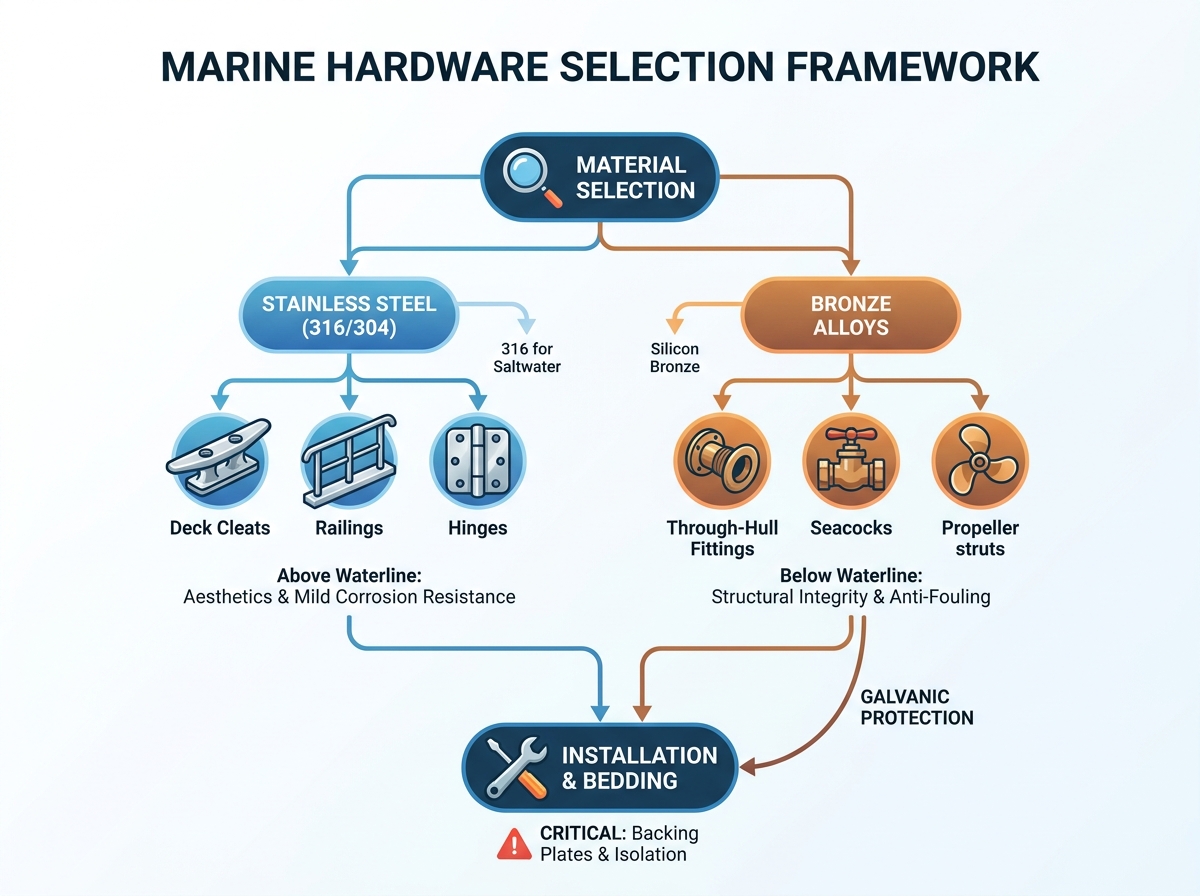
Marine environments are notoriously unforgiving. Selecting the right components goes far beyond mere visual appeal. Poor component choices actively compromise structural integrity and passenger safety. They also invite rapid saltwater corrosion and catastrophic mechanical failures. Successful procurement requires balancing initial performance limits against long-term durability. We must minimize maintenance cycles while ensuring seamless compatibility across your entire vessel infrastructure.
In this comprehensive guide, you will learn how to categorize essential structural components accurately. We explore the critical metallurgical differences between standard alloys and marine-grade options. You will discover practical installation methodologies designed to prevent dangerous water intrusion. Finally, we provide a robust, compliance-driven framework. This helps you vet reputable vendors based on technical transparency. Properly specifying marine hardware is a fundamental risk-mitigation exercise for any boat builder or refit professional.
Key Takeaways
Material composition (e.g., 316 stainless steel vs. silicon bronze) dictates lifespan and application suitability more than brand name.
Proper categorization of boat hardware and accessories prevents critical omissions during refit or manufacturing phases.
Evaluating marine hardware suppliers requires looking past pricing to verify load-testing transparency, ISO certifications, and metallurgical documentation.
Installation methodologies (like proper bedding and backing plates) are just as critical as the hardware quality itself to prevent galvanic corrosion and water intrusion.
Categorizing Essential Marine Hardware by Application
Grouping components by their specific onboard application helps engineers and builders avoid critical design omissions. Proper classification ensures you procure the exact boat hardware and accessories required for each unique environmental stressor.
Deck and Mooring Hardware
Deck components endure massive dynamic loads during docking and anchoring. When evaluating cleats, chocks, and bollards, you must focus on Working Load Limits (WLL). Breaking strength is equally vital. You cannot guess these numbers. Ensure your mooring components match the vessel's specific displacement and anticipated windage. A heavy displacement yacht requires substantially thicker deck plating and oversized backing plates to distribute these extreme loads safely. Undersized cleats will simply rip out of the fiberglass during a storm.
Cabin and Functional Hardware
Interior components face entirely different challenges. Here, evaluation focuses heavily on ergonomics and vibration tolerance. Enclosed damp spaces trap salt-laden air. This accelerates corrosion on improperly finished parts. Pay special attention to high-cycle systems. Hinges and latches experience daily wear. Heavy-duty boat sliding door rollers must continuously resist binding. Salt crystal buildup easily destroys cheap roller bearings. Upgrading to sealed bearing systems prevents frustrating door jams and frequent replacements.
Structural and Rigging Components
Rigging components demand perfect dimensional accuracy. They handle complex, multi-directional load distribution. You must carefully specify marine tubing hardware for biminis, T-tops, and rail systems. Shear strength is non-negotiable for these structures. Passengers frequently grab rails during rough seas. Structural rigidity prevents catastrophic failures. Use solid bases and through-bolted connections. Avoid self-tapping screws in structural applications entirely.
Material Selection Criteria: Stainless Steel vs. Bronze Marine Hardware
Choosing the correct alloy dictates the operational lifespan of your components. Brand names mean very little if the underlying metallurgy fails to meet environmental demands.
304 vs. 316 Stainless Steel
Many builders misunderstand stainless steel grading. Alloy 304 is cheaper. However, it is suitable only for freshwater environments or light-duty interior use. Alloy 316 provides the necessary molybdenum content required for saltwater pitting resistance. Molybdenum creates a passive oxide layer. This layer prevents aggressive chloride ions from eating into the metal.
Alloy Grade
Primary Alloying Element
Best Application
Corrosion Resistance
304 Stainless Steel
18% Chromium / 8% Nickel
Freshwater / Cabins
Moderate (Vulnerable to chlorides)
316 Stainless Steel
Added 2-3% Molybdenum
Saltwater / Deck rigging
High (Resists pitting)
Bronze Marine Hardware
Underwater applications require completely different materials. High-quality bronze marine hardware shines in these hostile zones. Silicon bronze and manganese bronze are structurally superior for below-waterline applications. They perform exceptionally well for through-hulls and struts. Unlike stainless steel, bronze lacks susceptibility to crevice corrosion in oxygen-deprived water.
Bronze does have implementation realities you must consider. It is heavier. It carries a higher upfront cost. It also requires specific compatibility considerations. You must avoid dangerous galvanic reactions, especially near aluminum hulls or lower units.
Galvanic Corrosion Risks
Galvanic corrosion destroys metals silently. It occurs when you connect dissimilar metals in an electrolyte like saltwater. You need a strict framework for matching metals. Always reference a galvanic scale. We highly emphasize using sacrificial anodes (like zinc or aluminum). You must also install dielectric isolation pads when mixing materials on a single vessel. Separating stainless steel fasteners from aluminum masts prevents the aluminum from dissolving over time.
Implementation Realities and Installation Risks
Premium parts offer no protection if you install them incorrectly. Mechanical failures frequently stem from poor installation techniques rather than defective manufacturing.
The Cost of Poor Installation
Improper installation guarantees rapid failure. Stress cracking in fiberglass frequently occurs due to missing backing plates. When you bolt a heavy cleat directly to a deck, point loads concentrate around the fasteners. Over time, these point loads spider-web the gelcoat. They eventually compromise the underlying core. Always use G10 fiberglass, aluminum, or marine-plywood backing plates. These plates distribute the load safely across a much wider surface area.
Sealing and Bedding Best Practices
Water intrusion rots deck cores. Choosing the right bedding compound is essential.
Polyurethane: Offers massive adhesive strength. Use it for permanent installations above or below the waterline. It is very difficult to remove later.
Polysulfide: Excellent for teak decks and general hardware. Never use it on plastics like Lexan or PVC. It will chemically melt them.
Silicone: Good for insulating dissimilar metals. It seals well but offers no adhesive structural strength. Paint will not stick to silicone residue.
Match the compound to the hardware location carefully. Below-waterline through-hulls demand marine-grade polyurethane or specialized hybrid sealants.
Maintenance Baselines
Components require transparent upkeep assessments. Stainless steel is not completely stain-proof. It requires periodic passivation. Passivation removes free iron from the surface using mild acids. This simple chemical process restores the protective chromium oxide layer. Routine maintenance ensures you maintain your manufacturer warranty. It also guarantees long-term structural integrity.
How to Evaluate and Shortlist Marine Hardware Suppliers
Sourcing commercial quantities requires strict vetting procedures. A bad batch of metal can delay production lines or cause dangerous failures at sea.
Beyond the Catalog
Relying on a standard marine hardware store carries immense risk for bulk structural components. Retail stores rarely track individual metal batches. They cater to weekend DIY projects. Builders and refit yards need true professional vendors.
You must vet marine hardware suppliers meticulously. Demand full traceability of metal lots. Request Material Test Reports (MTRs) to prove the 316 stainless genuinely contains the required molybdenum. Evaluate their engineering support. Reputable suppliers provide precise CAD models. Engineers need these files for accurate structural modeling. Consistent inventory lead times are also crucial to keep your project on schedule.
Compliance and Certifications
Your shortlisting logic should be ruthless. Only accept suppliers whose components meet strict regulatory guidelines. They must meet or exceed ABYC (American Boat and Yacht Council) guidelines. They should also carry relevant ISO certifications for marine applications. ISO 9001 certification proves they maintain rigorous quality management systems. Component failures due to lack of compliance invite severe legal liabilities.
Warranty and Return Policies
Assess vendor liability before committing to a bulk purchase order. How do they handle defective batches? Will they cover the labor costs associated with removing out-of-spec parts? Review their return policies thoroughly. A supplier confident in their metallurgical quality will offer robust warranty terms.
Finalizing Your Procurement Strategy (Next Steps)
Transitioning from research to purchasing requires an organized approach. Structured procurement prevents budget overruns and mismatched equipment.
Creating a Standardized Bill of Materials (BOM)
Start by consolidating your SKUs. A standardized BOM ensures uniform material grades across the entire project. Do not mix 304 and 316 fasteners randomly. Standardization simplifies your inventory. It also gives you better leverage to negotiate bulk pricing discounts with your chosen vendor.
Testing and Validation
Never place a massive primary order blind. We strongly recommend ordering small sample batches first.
Inspect the thread tolerances on all fasteners.
Check the mirror polish finish for surface imperfections.
Examine weld integrity visually and request dye-penetrant testing reports if applicable.
Verify dimensions against your CAD models.
Physical inspection catches manufacturing flaws early. It saves significant time and frustration later.
Actionable Next Step
Do not wait until production stalls. Initiate a technical consultation with your shortlisted vendors today. Request their compliance documentation and MTRs. Ask them specific questions about their load testing procedures. Their response speed and technical knowledge will immediately reveal their reliability as a long-term partner.
Conclusion
Specifying marine components remains a vital risk-mitigation exercise. Your final selections directly impact vessel safety, structural longevity, and overall operational confidence. Always match the specific alloy to its intended environment. Keep bronze below the waterline and 316 stainless above it. Verify your supplier's technical credibility through CAD availability and ISO compliance. Finally, rigorously control the installation process using proper backing plates and appropriate bedding compounds. Following these steps guarantees a secure, reliable, and professional result.
FAQ
Q: What is the difference between 304 and 316 marine hardware?
A: The main difference is molybdenum. Alloy 316 contains 2-3% molybdenum, which dramatically increases its resistance to chloride-induced pitting. Alloy 304 lacks this element. Therefore, 316 is strictly required for saltwater environments to lower lifecycle costs, while 304 is limited to freshwater or cabin interiors.
Q: When should I specify bronze marine hardware over stainless steel?
A: Specify bronze for all below-waterline applications. Stainless steel relies on oxygen to maintain its protective layer, making it highly susceptible to crevice corrosion in stagnant water. Bronze alloys excel in oxygen-deprived environments, making them structurally superior for through-hulls, raw water strainers, and propeller struts.
Q: How do I verify the quality of parts from a new marine hardware store or supplier?
A: Always request comprehensive Material Test Reports (MTRs) to verify alloy composition. Ask for certified load-rating documentation. Conduct a physical inspection of sample batches. Check for flawless electropolishing, uniform thread tolerances, and clean, continuous welds without pitting or discoloration.
Q: Can marine tubing hardware be retrofitted to existing deck structures?
A: Yes, retrofitting is common. However, you must carefully verify base fitting compatibility and dimensional standards (e.g., matching 7/8" or 1" tube diameters). You must also evaluate the deck core. Always install proper G10 or aluminum backing plates to handle the new structural loads safely.